Prepared on behalf of the Peabody Awards, as a part of the 82nd Annual Peabody Awards social media campaign. Created by Katie Plowman in collaboration with Tunisha Singleton. Assets retrieved from Hulu.
Written and prepared for JRMC 8110, a graduate course at the University of Georgia. Co-authors and kickass teammates: Frankie Barnes, Spencer Bullard, Loredonna Fiore, Ansley Meccia, and Hollis Midkiff
Introduction
Artificial intelligence (A.I.) has consistently evolved over the years which has led to a variety of different definitions. For this project, artificial intelligence will focus on “the concept that machines can be improved to assume some capabilities normally thought to be like human intelligence such as learning, adapting, self-correction, etc.” (Kok, JN, 2009). Artificial intelligence has provided a foundation specifically for chatbots. Chatbots often combine the methods of machine learning and natural language processing which means they have the ability to improve predictive algorithms over time while analyzing text and speech (IBM Watson Advertising, 2022). One chatbot that has been gaining the attention of practitioners, scholars, and segments of the general public is ChatGPT. ChatGPT was trained and created by OpenAI, an American artificial intelligence research laboratory, and launched on November 30, 2022. OpenAI created ChatGPT “to answer follow-up questions, admit its mistakes, challenge incorrect premises, and reject inappropriate requests” which is supposed to reduce the harmful effects and answers earlier models could not discern (OpenAI, 2022).
This study addresses the gap between young adults, aged 18-26, their perception of ChatGPT software, and the increasing promotional usage of natural language A.I. for social media. The young adults’ perceptions were evaluated by measuring their attitudes, awareness, experience, and recognition of ChatGPT. Tools such as ChatGPT are being proposed as solutions to improve the work of advertisers and public relations practitioners, but there is a lack of research to understand how consumers are discerning the use of artificial intelligence. The capability to create social media content creates the potential for artificial intelligence to shape and alter social media. Social media is an important sector for advertising and public relations because consumers are constantly interacting with social media platforms (Sadiku, M., et al. 2021)
With the increasing advice to practitioners to implement chatbots into work, it is important to understand if consumers are responding in a positive, effective way for these tactics to be successful. Previous studies have shown evidence that users often feel the need to partake in “acts of resistance” to avoid algorithms and risks of data collection (van der Nagel, 2018). If consumers decide to partake in “acts of resistance” then the effectiveness of chatbot solutions is threatened. The researchers gauged the attitudes, awareness, experience, and recognition of ChatGPT to understand the current and future implications of natural language A.I. has social media content creation.
Literature Review
Overview of natural language A.I.
According to IBM, natural language processing (NLP) A.I. “gives computers the ability to understand text and spoken words in much the same way human beings can. NLP combines different technologies to enable computers to process human language in the form of text or voice data and to ‘understand’ its full meaning, complete with the speaker or writer’s intent and sentiment” (IBM). Some functions of natural language A.I. include “speech recognition, speech tagging, word sense disambiguation, named entity recognition, coreference resolution, sentiment analysis, and natural language generation” (IBM). Simply put, natural language A.I. essentially computes words/phrases that are spoken/typed into a device to complete tasks for the user.
The roots of natural language A.I. started in the 1900s when a need to spread the importance of language and the meaning it possesses to computers (Foote, 2019). “In 1952, Alan Turing developed the Hodgkin-Huxley model that showed how the brain uses neurons in forming an electrical network. These events helped inspire the idea of artificial intelligence, natural language processing, and the evolution of computers” (Foote, 2019). Fast forward to the 2000s, after other advancements were made, “Yoshio Bengio and his team proposed the first neural “language” model, using a feed-forward neural network in 2001. The feed-forward neural network describes an artificial neural network that does not use connections to form a cycle” (Foote, 2019). By 2011, “Apple’s Siri became known as one of the world’s first successful NLP/A.I. assistants to be used by general consumers” (Foote, 2019). These advancements have been greatly built upon today as technology advances in this field.
A new technology in the natural language A.I. space is ChatGPT. Developed by OpenA.I, ChatGPT is able to “interact with users in a conversational way. The dialogue format makes it possible for ChatGPT to answer follow-up questions, admit its mistakes, challenge incorrect premises, and reject inappropriate requests” (Schulman et al., 2022). There are, however, some limitations of the new technology. “ChatGPT sometimes writes plausible-sounding but incorrect or nonsensical answers, is sensitive to tweaks to the input phrasing or attempting the same prompt multiple times (for example, given one phrasing of a question, the model can claim not to know the answer, but given a slight rephrase, can answer correctly), and the model overuses certain phrases. The current models usually guess what the user intended. The model will also sometimes respond to harmful instructions or exhibit biased behavior” (Schulman et al., 2022). This biased behavior in NLP has been studied before. According to Hovy & Prabhumoye (2021), there are five specific biases in NLP systems. These biases include “the data, the annotation process, the input representations, the models, and finally, the research design” (p.1). These biases can impact the user experience depending on their demographic information, computer literacy, and the specific phrasing/vernacular they use.
Strengths and Weaknesses of Artificial Intelligence Bots
Machine learning (ML) is a sector of artificial intelligence that allows computers to collect data and create patterns or predictions. Natural language processing is a subset of machine learning, but often they are paired together in the use of chatbots, such as Chat GPT. Natural language processing is a type of artificial intelligence created to bridge a gap between computers and human vernacular. As natural language processing has emerged through various tools, including chatbots, both challenges, and opportunities have been presented. For this section of the research, a SWOT analysis was performed and summarized to understand several parts of NLP and machine learning. NLP and machine learning artificial intelligence in this analysis were examined based on the current forms that exist and potential forms that are expected.
These branches of artificial intelligence have several strengths that can be categorized into 3 themes: personal connection, automatic output, and business applications. While the initial idea of technology taking on a “human” character may seem odd, the success of NLP and ML A.I. is proof that personal connection is a huge strength of this technology. With machine learning, data and algorithms can be collected to continually imitate how humans speak and improve accuracy over time. Meanwhile, the use of natural language can promote “a relationship between users and systems or machines” (Marketdigits, 2021). We have seen this through users enjoying voice assistants, like Alexa or Siri, people continue to enjoy the ability to interact with devices or programs as they would another human. NLP and ML may give users a better sense of control with the expectation that computers adapt to a “human” way of speaking rather than vice versa.
The second theme for strengths seen in NLP and ML is the ability to automatically output. Many users, consumers, and practitioners are impressed by the system’s ability to quickly deliver prompts or answers. Rather than going through a typical search engine or strategic tactic to find an answer or idea, users and practitioners can use NLP and ML A.I. as effective ways to gain information or answers. The automatic output can create a positive user experience because it decreases the amount of work required by the human to receive the particulars wanted whether a consumer or practitioner.
Lastly, the theme regarding the business application may be the largest strength observed currently. NLP and ML A.I. have multiple abilities such as analyzing unstructured data, sentiment analysis, text extraction, or summarization. This A.I. offers more abilities than others and because of these abilities, this artificial intelligence has been and can continue to be used for customer service, educational/learning purposes for multiple subjects, content creation, or long text writing. Neither machine learning nor NLP are necessarily new topics, in fact, dating back to 1957 Noah Chomksy published a book discussing computers intimating the human thought process (Foote, 2019). Yet both continue to be incorporated as technology advances and as technology advances more opportunities are presented.
Natural language processing and machine learning A.I. have come a long way, however, there are still weaknesses that create challenges for both consumers and practitioners. These weaknesses are summarized into three themes: ethics, mistrust of institutions, and formulaic responses. Ethical concerns have been steadily increasing particularly due to chatbots such as ChatGPT. While NLP and ML allow systems to mimic human-like communication, there is still no emotional intelligence that can cause offensive responses to be generated. A recent example of this issue is the controversy over ChatGPT’s comments towards the Hindu religion (DNA Web Team). The growing mistrust from institutions involves these ethical dilemmas concerning personal morals but also academic/professional honesty.
Many companies or educational systems still view NLP and MI A.I. as a way of “cheating” work. This mistrust causes bans on institutional levels and can create a “taboo” around the idea. Apart from the ethical considerations, there is a practical weakness that NLP and ML A.I. revolves around formulating responses. These formulaic responses can cause a lack of creativity, limited answers, usage of templates, and non “aesthetic judgments”, or self-acknowledged incorrect/unknown answers (Bogost, 2022). As language and informal speech evolve, A.I. will have to evolve as well in order for the strengths to outweigh the weaknesses. If not, this can cause NLP and ML A.I. to fall behind if there are no capabilities to constantly be updated with evolutions. As NLP and ML A.I. continue to be utilized, opportunities will change and hopefully, challenges will be minimized. Many practitioners foresee these tools to continue to be integrated into advertising and public relations spaces. Understanding how these artificial intelligence tools work and how to control the risks will be crucial to success.
How has ChatGPT been used in advertising?
Even though chatbots got their start in 1966, the recent popularization of advanced chatbots, like ChatGPT, has everyone wondering what this technology can actually be used for.
In an academic context, some students are taking advantage of the software and using it to cheat on academic writing assignments (Klien, 2023). Others are using the software to develop schedules for their day, and just for general entertainment purposes. Computer science students and professionals are using the tool to fix errors in computer code, edit software, and identify potential issues in the programs.
Across the tech industry, Microsoft is implementing ChatGPT into its search engine software Bing to help users find more useful answers to queries (Vincent, 2023). The company hopes that this will increase user experience and encourage more consumers to use Bing over the biggest competitor, Google. Expedia is also implementing ChatGPT-4 functions into its iOS app, so users can plan itineraries, search for the best flight options, and even find dinner reservations. This function hopes to rise against its competitors, Tripadvisor and Booking.com. In the media, the implementation of this technology frames the companies as innovative and early adopters of an ever-changing world.
The advertising and public relations industry has felt both threatened and intrigued by the new technology. Some feel threatened because some feel that if ChatGPT and other natural language processing technologies become more advanced, then they can replace their jobs as writers and creatives. However, some are intrigued because this artificial intelligence can make their work more efficient and assist in the production of such materials making their jobs and lives easier.
In January of 2023, advertising saw the power of ChatGPT when celebrity Ryan Reynolds’s advertising agency Maximum Effort released an advertisement for Mint Mobile whose script was totally written by ChatGPT. The script fulfilled all of the criteria that the creator provided, but some argued that it still lacked the creativity of a human creative. Avocados From Mexico also used ChatGPT to generate a script for a Super Bowl commercial that was received well by both ad trade outlets and consumer outlets (Hiken, 2023). ChatGPT has also been used by social media managers to generate captions, brainstorm content ideas, and develop content calendars (O’Sullivan, 2023). Many feel that A.I. can be a benefit to the industry because then practitioners can focus on other things like design, management duties, and client relationships.
What are the ethical implications of A.I. usage in advertising?
Wherever technological advancements occur, controversy follows. Can society keep up? Can the advertising industry keep up?
Some experts believe there to be a “mismatch” right now, that society as a whole isn’t ready to embrace A.I. On the other hand, the conversation in itself is preparing us and progressing its lifecycle (Pelley, 2023).
While the average person may not use ChatGPT or other A.I. tools to help with their daily tasks, advertisers and marketers are already putting the phenomenon to work. Analyzing data, creating algorithms, writing copy and handling administrative tasks are just a few of the uses for A.I. tools in the AdPR field (Rodrigue, 2023).
So where does this lead us? Are our jobs on the line? Is using A.I. in a professional setting unethical or cheating, or is it simply keeping up with a changing playing field? Pelley goes on to acknowledge that “yes, there are some job occupations that’ll start to decline over time. There are also new job categories that’ll grow over time. But the biggest change will be the jobs that’ll be changed. Something like more than two-thirds will have their definitions changed. Not go away, but change…they’re now being assisted…this is a profound change which has implications for skills” (2023).
The idea of A.I. usage in the advertising profession is a divisive topic. Some industry leaders are actively warning against its use, while others are embracing it and coaching their teams to adapt and learn new skills. BBDO CEO Andrew Robertson has been an active skeptic, telling staff members not to use A.I. for client work unless “it’s approved by the agency’s legal team” or “speaking to leadership” first (Konstantinovic, 2023). Why? It isn’t foolproof. A.I., as advanced as it may seem, isn’t flawless. It still lacks distinct human creativity and originality. (Pelley, 2023).
While those qualities are lacking, tools like ChatGPT are incredibly efficient— leaving more time for human workers to express creativity in their work rather than getting hung up on mundane tasks. According to a MIT study, workers who used ChatGPT to write messages for them accomplished the task 59% quicker than those who didn’t (Wylie, 2023).
Overall, while there are adopters and skeptics alike, ChatGPT is not taking over society— yet. For now, tools like ChatPGT are mostly being utilized as aids in efficiency, not simulating human creativity. That day may come sooner rather than later, but human supervision will always be required in one way or another for monitoring purposes.
Current Attitudes towards A.I. in advertising
Research surrounding artificial intelligence in advertising and consumer attitudes toward it has been limited. As the advertising industry is just now branching into the A.I. resources that exist, there is not an extensive amount of research on how consumers feel about the new technology being applied to their everyday consumer experience.
The bit of research that does exist revolves primarily around how brands have incorporated artificial intelligence into consumers’ online shopping experience and how digital content is now being designed specifically for them. With consumers shopping more and more online every day, 80% of those who classify themselves as frequent shoppers say they only shop with brands that personalize their experience (Wunderkind, 2022). This is a good sign for advertisers that have a significant online and digital presence – especially for brands that are retail and product-oriented leading consumers to purchase products from their online platforms.
Unfortunately, 45% of responding consumers expressed a lack of understanding of how artificial intelligence and machine learning technologies work (Statista, 2023). This can be a concern for advertisers as their consumers may be misled and confused when A.I. starts interacting with them online. Older audiences for example may be alarmed that they are communicating with a bot and that it has their shopping preferences saved online. That may deter some consumers from shopping with those brands as they do not feel that the brand is trustworthy or that their information is safe online.
However, younger audiences have mostly positive reactions when it comes to A.I. being used in their digital advertising and consumer experiences. In fact, 71% of customers expect companies to communicate with them in real-time, which is why using an A.I. conversational marketing solution to engage with customers and prospects has become increasingly popular amongst larger brands (IBM, 2023).
So far when it comes to artificial intelligence in advertising, consumers do not seem to have an issue with it. The biggest concern for advertisers at the moment is that a large population of consumers does not understand the application of artificial intelligence when it comes to advertising.
Based on very limited research within the advertising artificial intelligence community, if consumers understand and are aware of it, they do not have an issue with their shopping experience being personalized. Most shoppers say they prefer a personalized approach from brands, however, this will most likely differ between generations. Younger generations will likely not have an issue with A.I. interaction as so many digital platforms have exposed them to it already, whereas older generations may be skeptical.
Future advancements in A.I. technology
According to industry experts, scholars, and business trends, investments into natural language processing research and implementation will only continue to increase in the future. Because of this, further advancements will be made in machine learning technologies. Researchers at Microsoft believe that the “next 10 years will be a golden age in NLP development” (Zhou, et. al., 2018). They attribute this to big data becoming easier to collect, process, and archive, which will allow NLP technology to enhance the capabilities of customer service tools, sentiment analysis, SEO optimization, and content generation.
Currently, the broadest use of A.I. in marketing has been focused on personalization, audience segmentation and targeting, and recommendation engines to improve consumer experience and provide more specific demographic and psychographic information to marketers (Yager, 2020). More specifically, it can be used as a tool to generate push notifications, headlines, digital ad copy, and campaign deliverables. However, in the upcoming years, it is predicted that NLP will be specifically adopted to generate the actual content consumers will interact with. In terms of customer service, conversational A.I. tools will be smarter, such as chatbots and digital workers. Companies will use NLP to edit, paraphrase, and generate copy in campaigns that are highly specific to their target audiences. NLP sentiment analysis usage will become more refined to provide actionable insights and a deep understanding of consumer issues, especially in E-commerce when it comes to product reviews and recommendations (Dilmegani, 2023).
Current and future research for NLP mainly consists of refining the present technologies to better recognize and categorize the contextual complexities of language. Context can entirely change a word or phrase, which can be difficult for software to identify. Synonyms, homonyms, sarcasm, irony, idioms, and culture-specific expressions all contribute to the context and meaning of sentiment, which is why advanced machine-generated content is still arguably a few decades away (Khurana, et. al. 2022). Research must also be conducted to use NLP in a broader geographic sense, both globally and by specific industry (healthcare, finance, law, etc.).
Furthermore, research about A.I. usage in marketing will need to be explored through a lens of consumer perception in attitude. This study specifically addressed awareness and attitude towards ChatGPT on a small scale, but future studies need to be broader and more diverse. A survey of 2,500+ Americans conducted by Treasure Data in 2022 found that “while consumers are open to the benefits of personalization that A.I. provides, marketers still have work to do to make those interactions feel truly personal and valuable” (Cision, 2022). Human connection and data privacy are major points of consumer contention when interacting with A.I.. As familiarity and understanding of how these technologies function become more widely adopted, researchers and practitioners will have to conduct further qualitative research to ensure consumer comfortability. A.I. may be able to generate content, but if it is not perceived well by the intended audience, it invalidates the usage.
The current limitations of NLP in marketing include the need for large and rich sets of data and the inability of machines to fully understand the entire linguistic range of emotion and subjectivity. The resolution of these inabilities through future research will allow marketers to use NLP not only to improve the present consumer experience, but to make programmatic predictions. A.I. is becoming integral to marketing, and will eventually inform content creation, target audience identification, powerful algorithms for personalization, and customer support bots. However, language and cultures also always continue to develop and evolve, so a human perspective, and a human touch, will most likely always be needed. Until further technological advancements are made, and the ethics behind A.I.-generated content have a more solidified legislature, A.I. and NLP tools should be used as a crutch, not an entire solution.
Discussion of Theory
In an effort to guide our primary research study, we selected two theories that support our overall research question of Generation Z’s attitudes towards A.I. in advertising. The first of these theories is Generational Cohort Theory (GCT). Generational Cohort Theory “is the concept that a generation of individuals that share the same political, economic, and social events during the early stages of life will develop a similar set of beliefs, values, and behaviors” (UofC Berkeley, n.d.). Our research targets Generation Z specifically and the GCT suggests that if you can study a generation’s current preferences and habits, you can predict how they may uphold or change those habits in the future. For example, how their generation feels about A.I. in general and if artificial intelligence is likely to stick around in the future as Gen Z becomes societal leaders.
The second theory to support our research is the Diffusion of Innovation theory (DOI). Diffusion of Innovation is a concept that “explains how, why, and at what rate new ideas and technology spread throughout a society” (Rogers, 2010). Our research is focusing on a new artificial intelligence program, ChatGPT, that just became available to public audiences in November of 2022. With the A.I. platform being so new on the market, DOI theory can support our research in establishing which phase of diffusion this technology is in, how fast society is adapting to this particular A.I. program, and determining if ChatGPT will soon become a wide-spread and commonly used application on everyday smart devices. Our research team’s initial thought was that due to ChatGPT just recently being launched on public platforms in the United States, it would fall in the early adopter category on the diffusion bell curve. However, our research showed that a majority of Gen Z is aware of the platform and has used the software frequently. This shifted our placement of the ChatGPT application on the diffusion curve to be closer to the early majority phase and further from the early adopter phase. We determined that the A.I. platform is best suited to currently be in a “transitional stage” between the early adopter and early majority categories.
Method
Participants
Respondents were able to share their responses via Qualtrics, an online survey tool. The sample consisted of 172 participants who were selected through convenience sampling. The participants ranged in age from 18 to 26 years old, since we chose to only focus on Generation Z. Majority of participants were female (72.7%), and the minority of participants were men (25.6%). Ages were distributed as an even bell curve with the majority of participants being 22 (25.6%), and the least being 18 and 26 (0.6%, or one respondent).
Materials
As previously mentioned, the survey questionnaire was developed using Qualtrics. The questionnaire consisted of multiple choice, Likert scale, select all that apply, and open-ended questions.
Procedure
Participants were recruited using GroupMe, Twitter, LinkedIn, Facebook, and individualized text messaging. They were asked to complete the survey at their convenience, with no time limit or restrictions on their responses. The survey was available online for one week and one day, during which time participants could access and complete it.
Data Analysis
The data collected from the survey were analyzed within Qualtrics by using the “StatsiQ” feature. Inferential statistics, such as t-tests and ANOVA, were used to test correlation and determine whether significant differences existed between groups. Since few statistically significant results were found, the team used percentages and inferred the relationships of the variables.
Ethical Considerations
All participants provided informed consent before completing the survey. The data collected were kept confidential and anonymous, and the survey data will remain within Qualtrics to ensure security.
Limitations
One potential limitation of this study is the use of a convenience sample, which may not be representative of the broader population. Additionally, the use of self-reported data may be subject to bias or inaccuracies. Finally, the survey questionnaire was limited to closed-ended questions, which may not capture the full complexity of participants’ attitudes towards the topic.
Results
What is Gen Z’s Awareness of ChatGPT?
Gen Z is on the cusp of the early adopters and early majority phase of ChatGPT awareness and use. The survey automatically discarded participant responses of those who had not heard of the platform. Because of this, 100% of the respondents have heard of ChatGPT. Out of all respondents, 44% have used ChatGPT and 55% have not used ChatGPT.
Respondents have mostly seen ChatGPT used in an academic or recreational setting. The majority initially heard of ChatGPT from friends, social media and in school. Outliers include respondents hearing of the platform from popular television show, “South Park,” parents or family, and radio. It is worth noting that because the pool of respondents came from convenience sampling, these data reflect common factors most respondents share.
There was no correlation between age and awareness (with a p-value of 0.34) or gender and awareness (with a p-value of 0.091). However, most notably, more men have heard of and used ChatGPT than women. This supports the diffusion of innovation theory, which postulates that more men are typically identified as early adopters of new and emerging technologies.
Furthermore, respondent awareness of ChatGPT usage in social media and advertising was measured. 45.9% of respondents are aware that ChatGPT is used to create social media content, however, 93% were not aware of a specific company that has used ChatGPT for advertising. Currently, there are limited sizable, notable companies who are creating content solely using ChatGPT. To reiterate, the program is largely used as a conceptual and research tool. This is somewhat reflected in how respondents consider ChatGPT’s abilities. The majority of respondents recorded that ChatGPT can be used to write documents, draft emails and write advertisements. Respondents also believe that ChatGPT is mainly used for academic, recreational and professional purposes, as opposed to phishing or hacking. These data help inform later data surrounding general sentiment of the platform.
What is Gen Z’s Recognition of ChatGPT?
Two mock Instagram posts were embedded into the survey, the order randomly generated for each participant. The same picture (left image) was used for both posts. One caption was written by a group member and the other was written by ChatGPT after given a generic request to generate an Instagram caption about a Caribbean vacation on behalf of Sandals Resorts:
The ChatGPT caption (center image): “Paradise found at Sandals Resort ☀️🌴 Escape to our luxurious oasis for an unforgettable vacation filled with endless sunshine, turquoise waters, and pure relaxation. #SandalsResorts #LuxuryIncluded #BeachVacationGoals”
The group’s caption (right image): “Indulge in a rejuvenating escape at Sandals Resort, where instant relaxation awaits your arrival 🌸 Enjoy beach access, private pools, and secluded balconies. #SandalsResorts #CaribbeanVacation” (IM_ehe7tNLvNFpGcdg)
Most participants (79.7%) knew one of the captions was generated by A.I. Most participants (90 people) answered correctly in which one they thought was generated by ChatGPT (IM_7amTCW5YNPc8Ld4- Chat gpt).
What are Gen Z’s Attitudes towards ChatGPT?
Generation Z has a variety of attitudes towards ChatGPT and brand usage of ChatGPT for social media content creation. In regards to describing their experience using ChatGPT specifically, there was a diversity of sentiments towards ChatGPT use. In terms of a user-friendly experience, 45.3% of respondents reported strongly agree and 46.&% of respondents reported somewhat agree creating a large majority in some variety of positive feelings towards ChatGPT’s user-friendliness. Concerning uselessness, whereas 62.7% strongly disagreed that ChatGPT was useless and 25.3% of respondents somewhat disagree. Concerning trustworthiness, most reported they somewhat agree that ChatGPT is trustworthy with 38.7%, yet 32% neither agree nor disagree. Regarding helpfulness, 45.3% of participants recorded that they strongly agree ChatGPT is helpful and 45.3% of participants recorded they somewhat agree it is. In regards to describing ChatGPT as disturbing, 25.3% reported they neither agree nor disagreed. However, 24% somewhat agreed that it was disturbing and 20% somewhat disagreed that it was disturbing. Concerning accuracy, 56% of participants somewhat agree that ChatGPT was accurate and only 16% of participants reported somewhat disagreeing that it is accurate.
Generation Z respondents reported a variety of what they they have heard about ChatGPT. 46% of participants reported hearing somewhat positive reaction and 21% reported hearing mostly positive reactions. Overall, the majority of responses responded within the choices of positivity. When looking at predictions for the future, 40% of respondents believe brands will fully adopt the usage of AI content creation machines in the future. When looking at usage of ChatGPT for personal content creation, 48% of respondents would not use ChatGPT for their social media content, whereas 52% would use ChatGPT for their social media content.
In terms of social media content creation, 64% of the respondents reported neutral feelings towards the company overall if a brand were to use ChatGPT for caption creation. This percentage slightly dropped to 57.6% of respondents reporting neutral feelings when asking how they would feel exclusively about the company’s social media. When diving deeper into specific capabilities of ChatGPT, only 6% of respondents believe ChatGPT can produce social media content that is very trustworthy. Although 54% of respondents did not feel ChatGPT is trustworthy or not. Regarding creativity, only 8% of respondents believe ChatGPT can produce extremely creative content. Yet the largest percentage was 41% of respondents believing that the work could produce somewhat creative content. Concerning quality, 48% of respondents believe that ChatGPT can produce somewhat high quality work. Concerning informative capabilities, 48% of respondents reported ChatGPT can produce somewhat informative content.
The results reported different preferences for what aspects of social media content are generated by ChatGPT. The majority of respondents, 61.6%, agreed that companies could use ChatGPT to generate captions. However, 25% of the respondents answered saying that none of the options listed are acceptable for brand usage of artificial intelligence on social media.
The results also reported different preferences for what industries could use artificial intelligence and general social media content creation. The most approved industry for ChatGPT content creation is travel/hospitality with 54.1% of respondents. The least approved industry for artificial intelligence generated content creation was politics/n ews with only 16.9% of respondents selecting it as an option. Although, 20% of respondents do not see any industry listed as appropriate for ChatGPT use.
Social media disclaimers are a way to communicate an aspect of the content. The survey gave insight into feelings about disclaimers for social media content, specifically in regards to caption creation. According to the survey, 42% of respondents would want disclaimers for captions or posts created by ChatGPT. Whereas 24% of respondents would not disclaimers for captions or posts created by ChatGPT.
What is Gen Z’s Experience with using ChatGPT?
Gen Z’s overall experience using ChatGPT is still relatively limited. 59.1% of male respondents have used ChatGPT whereas only 37.6% of females have used ChatGPT. 100% of non-binary respondents have used ChatGPT. The majority of our respondents at 50.7% have only used ChatGPT 1-3 times. However, if respondents have used ChatGPT, 69.2% have used it for academic purposes.
In terms of using ChatGPT for social media, there is no statistically significant relationship between social media use and ChatGPT experience. Most respondents who have used ChatGPT before are unlikely to use it for personal content production. However, most notably, 45.3% of respondents who have used ChatGPT would use it to generate ideas on what to post.
When comparing results between education level and ChatGPT experience, there is no statistically significant relationship. This could be due to our limited sample size in terms of amount and diversity. There was also not a statistically significant relationship between ChatGPT experience and area of study, but most notably, 48.6% of respondents who had used ChatGPT before are in the field of liberal arts.
The strongest statistically significant relationship is between the variables of how many times a respondent has used ChatGPT and the likelihood of using it again. It can be reasonably assumed that the more times a respondent has used ChatGPT, the more likely it is they will use it again.
This relationship further informs general sentiment of the platform. Of the respondents who have used ChatGPT 10 times or more, only 5.9% strongly agree that it is disturbing. 21.1% of respondents that have only used the platform 1-3 times strongly agree that it is disturbing.
70% of users that have used ChatGPT 10 or more times strongly agree that it is user-friendly. However, only 17.6% of those same groups strongly agree that it is accurate, and only 5.9% strongly agree that it is trustworthy. These data could suggest that the more people use ChatGPT, the less disturbing they find it, but the more likely they are to find inaccuracies and issues with the information the program provides.
The more familiar ChatGPT becomes to the public, the more widely accepted the format will likely become unless inaccuracies are left unresolved. According to our data, there is a negative correlation between ChatGPT experience and attitude toward brand use of ChatGPT. Respondents who have used ChatGPT before having a strong dislike for brands using ChatGPT to write social media posts. This relationship could be attributed to more experienced respondents being familiar with A.I. limitations in terms of emotion, accuracy, and trustworthiness. Early adopters will most likely use ChatGPT for basic and exploratory functions, as opposed to personal content generation.
Conclusion
This study researched the attitudes, awareness, experience, and recognition of Generation Z regarding ChatGPT and social media creation. Through the results, the research is able to support implications and insights surrounding the topic. This research continues to support the diffusion of innovation theory. In addition, it offers findings that give practical and managerial implications for how marketers/advertisers/media planners decide to use artificial intelligence for social media for content creation and/or integrate artificial intelligence into practices.
Theory Contributions
The results of this study provide insights into the stage of artificial intelligence chatbots in the diffusion of innovation theory for Generation Z. Based on the results, ChatGPT and artificial intelligence are transitioning from early adopters to the early majority stage which implies that while Generation Z may be aware of ChatGPT, they may still be looking for information to overcome hesitations. Clarifying where chatbots, such as ChatGPT, place on the diffusion of innovation theory provides an understanding of how practitioners in artificial intelligence and practitioners in marketing/advertising/media planning approach and inform consumers. Practitioners of these industries may find disclaimers and transparency helpful resources to move this technology fully into the early majority stage. In order for technology like ChatGPT to be widely accepted, skepticism will have to be addressed. While Generation Z is open to using artificial intelligence like ChatGPT, the results imply there is not a stable relationship with technology as such. This comes from a lack of understanding of the capabilities or benefits. While users may be more likely to be comfortable, the more they adopt this technology there is no evidence to support that a consumer is building a relationship or reliance with the brands creating these platforms. Developers of software should be aware of this hurdle and continue to take steps to minimize concerns in order to fully move into the successful stages of the diffusion of innovation theory. The results also enforce the diffusion of innovation in regard to gender differences by results supporting that males are more likely to be early adopters. There is little This could imply a need for different approaches to different genders for this technology. These results support the continued use of diffusion of innovation to analyze subjects related to artificial intelligence.
Practical and Managerial Implications for Media Planners
The results of this study provide important practical and managerial implications for marketers/advertisers/media planners regarding social media content creation in relation to artificial intelligence. Artificial intelligence such as ChatGPT provides interesting opportunities to create several types of content. Social media presence can be an important influence on consumers’ perceptions of a brand as a whole. The results of this study inform practitioners of what consumers feel is acceptable and what consumers are aware of. Our results show that Generation Z is adopting the use of artificial intelligence, but still has some hesitation toward personal and brand usage
The results show that hesitation or approval may depend on what industry a brand is categorized in. The participants in our study showed a preference for what industries decide to partake in artificial intelligence social media creation. This research shows that practitioners in less scientific or sensitive topics would receive less criticism or negative perceptions if deciding to use artificial intelligence for content creation. Whereas, subjects that may be more vulnerable to controversial topics or scientific backgrounds are not as accepted. Consumers’ differing opinions on industries may affect when practitioners decide to implement artificial intelligence into their marketing/advertising/media plans.
In addition to the concern of what industries use chatbots like ChatGPT for content creation, the results showed that there is greater comfortability towards certain aspects of content creation. Consumers’ comfortability gives insight to practitioners that using artificial intelligence for creating captions would be most acceptable, whereas other content aspects would be perceived in a positive light. How practitioners choose to engage with consumers through artificial intelligence could create discomfort and should be avoided. Therefore, the differences in preference for what industry and types of content creation generated by artificial intelligence should be considered by practitioners before engaging in artificial intelligence social media content creation. The insights provided by this report show that despite hearing some sort of positive reactions regarding ChatGPT, these positive feelings may not be relayed into the professional usage of ChatGPT. Practitioners wanting to utilize artificial intelligence should consider how to take advantage of the positive buzz in this generation and translate it to the professional usage of brands. When crafting advertising and media placement, this research supports that certain practices may be received more positively.
Limitations
Our research on consumer opinions and attitudes on A.I. generated social media content has limitations regarding generalizability. Specifically, our survey respondents were highly skewed by demographics. For example, a majority of respondents (72.67%) were women, live in Georgia (70.93%), and are pursuing their bachelor’s degree (52.33%). A majority of our respondents (44.38%) were also in the field of communications, which means they may be abreast of ChatGPT and the ethical dilemmas the field is currently facing in advertising.
Future research
Future research should replicate the study in other age groups. It would be interesting to compare results depending on age and comfortability with technology (generation alpha, millennials, generation X). This could make the findings more generalizable. Future research should also use more random sampling that takes into account a wider demographic scope (location, education level, gender, etc.). This will help ensure the data is a truly representative sample of consumer attitudes.
Along with demographic information, future research should continue to explore consumer attitudes as technology/exposure of the platform grows. Since ChatGPT is gaining traction in the media and in education fields, studies should be done every 6 months. This data could be interesting to cross-reference and compare as time goes on and more information is disseminated to the public.
Future research should also explore consumers’ attitudes toward other forms of content besides social media. For example, a study should be done to gauge consumer attitudes on A.I. content creation of websites, press releases, news, press conference scripts, etc. This will help identify the “line” in which consumers do not want NLP A.I. to cross regarding the content they consume. According to our current survey, there were certain fields that participants felt comfortable with having A.I. generate content for (the highest is 90 respondents with travel and hospitality). Since our social media sample included a travel destination post, this might have skewed the results. Future research should include multiple fields of content creation (health and wellness, political news, entertainment, etc.) to ensure participants are not led to choose a field based on the survey itself.
Our research and future studies can also inform the promotion of ChatGPT. By using the findings from our survey and future studies, specific campaigns can be geared towards gen z (and other age groups) to encourage the use of ChatGPT. For example, ChatGPT might want to advertise its planning/schedule-creating capabilities for college students. The more data collected about consumer attitudes, the more ChatGPT, and even industry categories can gauge consumer attitudes on what/when to incorporate NLP A.I.
Acknowledgments
The team would like to take some time to thank Dr. Yoon for her continued support and flexibility during the research process. Her patience and willingness to help us succeed did not go unnoticed during this project. We also want to thank Walker’s Coffee Shop for allowing us to use their largest booth and for not kicking us out when we were a little too loud. Special thanks to all of the group members for contributing equally and carrying us through the semester. You guys are the best. See you in the career field! – Team A.I.
References
Aydın, Ö., & Karaarslan, E. (2023). Is Chatgpt leading generative ai? what is beyond expectations? SSRN Electronic Journal. https://doi.org/10.2139/ssrn.4341500
Hovy, D., & Prabhumoye, S. (2021). Five sources of bias in natural language processing. Language and Linguistics Compass, 15(8), e12432. https://doi.org/10.1111/lnc3.12432
Hovy, D., & Prabhumoye, S. (2021). Five sources of bias in natural language processing. Language and Linguistics Compass, 15(8), e12432. https://doi.org/10.1111/lnc3.12432
Khurana, D., Koli, A., Khatter, K., & Singh, S. (2022, July 25). Natural language processing: State of the art, current trends and challenges – multimedia tools and applications. SpringerLink. Retrieved April 27, 2023, from https://link.springer.com/article/10.1007/s11042-022-13428-4
Kok, J. N., Boers, E. J., Kosters, W. A., Van der Putten, P., & Poel, M. (2009). Artificial intelligence: definition, trends, techniques, and cases. Artificial intelligence, 1, 270-299.
Sadiku, M., Ashaolu, T. J., Ajayi-Majebi, A., & Musa, S. M. (2021). Artificial Intelligence in Social Media. International Journal of Scientific Advances, 2(1), 15-20.
We are student researchers at The University of Georgia. We invite you to participate in a study to understand your perceptions and opinions on A.I. generated social media content. This study is conducted solely for a class project of JRMC 8110 (Media Planning) to fulfill a course requirement under the direction of Dr. Hye Jin Yoon (hjyoon@uga.edu), an Associate Professor in the Grady College of Journalism and Mass Communication at The University of Georgia. We would greatly appreciate it if you accept our invitation and participate in this study. It will take approximately 10 minutes to complete. You must be 18 years of age or older to participate.
Per the UGA’s IRB policy for class projects
(https://research.uga.edu/docs/policies/compliance/hso/Guidance-Class-Projects.pdf), this class project does not meet the regulatory definition of research requiring the submission of an IRB application for approval because the study involves human subjects solely to fulfill a course requirement without an intent to develop or contribute to generalizable knowledge.
Though this study does not require an IRB approval, general principles of ethical research with human subjects will be carefully observed by the researchers. Our research plans and research activities are going to be continuously reviewed and
monitored by the course instructor, Dr. Hye Jin Yoon, to ensure that the participants are protected in terms of their privacy and confidentiality. Please note that this participation is completely voluntary, so you do not have to participate in the study if you don’t want to, and that you can stop participating at any time.
There are no direct benefits or compensation to you for participating in the study; and there are no known risks to you for participating in this survey and we will employ standard confidentiality procedures. We promise not to share any information that identifies you with anyone outside this class. The results of the research in summary form may be shared with the client, but your name or any identifying information will not be used. We ensure that the data collected from this study are not used or shared beyond the circumstances described below:
1. In the classroom;
2. If the project involves gathering data from or about a company, agency, or organization, the data/results are shared only with that company, agency, or organization; and/or
3. Presentations of project results at Departmental, Interdepartmental, College, or University seminars or similar venues designed to exhibit coursework or to continue the learning process.
If you have any questions or concerns about completing the questionnaire or about being in this study, please contact Spencer Bullard at spencer.bullard@uga.edu. Questions or concerns about your rights as a research participant should be directed to The Chairperson, University of Georgia Institutional Review Board, telephone (706) 542-3199; email address irb@uga.edu.
Sincerely,
JRMC 8110 A.I. Research Team
Faculty Adviser: Hye Jin Yoon, Ph.D.
Grady College of Journalism & Mass Communication
University of Georgia
By clicking “I consent” at the bottom, you are agreeing to participate in the above described research project.
Survey Questions
How old are you?
18
19
20
21
22
23
24
25
26
27+ (skip logic to end page of survey)
Awareness questions
1. Have you heard of Chat GPT and its natural language processing and machine learning functions?
a. I have heard with the platform and have used it
b. I have heard of the platform but have not used it for myself
c. I have not heard of the platform (skip logic to end of survey)
2. Where have you heard about Chat GPT? Select all that apply:
a. In school
b. At work
c. Social media
d. News channels
e. Friends
f. Other (please specify):
3. If you are familiar with Chat GPT, how have you seen it used? Select all that apply: a. Academic purposes
b. Professional/work purposes
c. Recreational purposes
d. Social media content creation
e. Computer coding purposes
f. Hacking/ Phishing/ Scamming purposes
g. Other (please specify):
4. As far as I know, companiesuse Chat GPT to create content for social media. True or False?
a. True
b. False
5. Do you know of a company that has used A.I. (like Chat GPT) in an advertisement? a. Yes (please specify):
b. No
6. Which of the following can Chat GPT be used to do? (Select all that apply)
a. Write documents such as poems, cover letters, and papers.
b. Answer questions regarding computer coding and software development. c. Write advertisements
d. Draft emails
e. Create a schedule after giving it a list of tasks
f. Give advice about mental health
g. Other: _____
Experience questions
Have you ever used Chat GPT?
a. Yes
b. No (if no, skip logic to next section)
Since you have used ChatGPT, what have you used it for? (Select all that apply)
Academic purposes
Professional/work purposes
Recreational purposes
Social media content creation
Computer coding purposes
Hacking/ Phishing/ Scamming purposes
Other (please specify): _____
How many times have you used Chat GPT?
a. 1-3 times
b. 4-10 times
c. More than 10 times
If yes, please rate your experience,
a. 5 point likert of hard-to-use to easy-to-use
b. 5 point likert scale of unhelpful to helpful
c. 5 point likert scale of inaccurate to accurate
d. 5 point likert scale of untrustworthy or trustworthy
e. 5 point likert scale of likely to use it again
How likely are you to use ChatGPT again?
5 point likert scale
Recognition questions
1. Show two mocked-up Instagram posts, both with the same photo (left image), but different captions. One Chat GPT generated (center image), one human-written (right image):
The ChatGPT caption (center image):“Paradise found at Sandals Resort ☀️🌴 Escape to our luxurious oasis for an unforgettable vacation filled with endless sunshine, turquoise waters, and pure relaxation. #SandalsResorts #LuxuryIncluded #BeachVacationGoals.”
Note: Qualtrics labeled this image “IM_7amTCW5YNPc8Ld4.”
The group’s caption (right image): “Indulge in a rejuvenating escape at Sandals Resort, where instant relaxation awaits your arrival 🌸 Enjoy beach access, private pools, and secluded balconies. #SandalsResorts #CaribbeanVacation”
Note: Qualtrics labeled this image “IM_ehe7tNLvNFpGcdg.”
a. Which caption do you like better?
2. Here are two examples of social media copy. Do you believe:
a. Neither captions are written by A.I.
b. One of the two captions is written A.I.
c. Both captions are written by A.I.
3. One of these captions is written by Chat GPT. Which caption is written by Chat GPT? a. A
b. B
4. Caption of image “IM_7amTCW5YNPc8Ld4” is written by Chat GPT. How does this knowledge make you feel?
a. 5 point likert of not surprised to surprised
b. 5 point likert of uncomfortable to comfortable
Attitudinal questions
In terms of social media content creation, do you think Chat GPT can produce content that is…
a. Creative (5 point likert scale)
b. Quality (5 point likert scale) [high vs. low]
c. Accurate (5 point likert scale)
d. Informative (5 point likert scale)
e. Trustworthy (5 point likert scale)
Have you heard mostly positive reactions or negative reactions regarding Chat GPT?
a. 5 point likert scale Positive-Negative
Would you want to know if a caption or post was created by Chat GPT via a disclaimer?
Yes
No
No preference
If you knew a company used Chat GPT to create social media captions, how would that impact your feelings about the company overall?
a. 5-point Likert scale
If you knew a company used Chat GPT to create social media captions, how would that impact your feelings about the company’s social media content?
a. 5-point Likert scale
If a company uses ChatGPT to write social media captions, you would feel that the company is…
Innovative
Cheating
Misleading
Efficient
Which of the following should brands use A.I. for on social media? (Select all that apply)
a. Creating captions
b. Generating pictures
c. Writing bios
d. Messaging consumers (direct messaging)
e. None of the above
f. Other:_______
Which brands are acceptable for A.I. content creation?(Select all that apply)
a. Health/Wellness
b. Beauty/Fashion
c. Sports/Gaming
d. Technology/Science
e. Arts/Entertainment/Culture
f. Food/Drink
g. Travel/Hospitality
h. Politics/News
i. Business/Finance
j. None of the above
k. Other:_______
How would you use AI generated content for your own social media content curation? (Select all that apply)
a. To create and edit images
b. To write my captions
c. To write my bio
d. To generate ideas on what to post
e. I would not use A.I. to generate my own social media content
Do you think that brands will fully adopt the usage of AI content creation machines in the future?
a. 5-point Likert scale
Demographic questions
Which social media platforms do you use? Select all that apply:
Instagram
Facebook
Twitter
TikTok
e. Reddit
f. Other: [please specify]
2. How often do you use social media?
a. 1-2 hours a day
b. 3-4 hours a day
c. 5-6 hours a day
d. More than 6
e. I do not use social media daily
3. Do you find new advancements in technology exciting?
a. 5-point Likert scale
4. Do you think that advancements in A.I. technology (like Chat GPT) are beneficial? a. 5-point Likert scale
5. What’s the highest level of education you have completed?
a. Less than high school diploma/GED
b. High school diploma/GED
c. Currently pursuing bachelors degree
d. Currently pursuing masters degree
e. Currently pursuing professional degree
f. Completed bachelor’s degree
g. Completed masters degree
h. Completed professional degree
6. What is your area of study?
a. Science, Technology, Engineering, and Math (STEM)
b. Performing and Fine Arts
c. Liberal Arts (Communications, Political Science, English, etc.) d. Education
e. Business
f. None of the above
g. Other (please specify):
7. What industry do you currently work in?
a. Health/Wellness
b. Beauty/Fashion
c. Sports/Gaming
d. Technology/Science
e. Arts/Entertainment/Culture
f. Food/Drink
g. Travel/Hospitality
h. Politics/News
i. Business/Finance
j. None of the above
k. Other:_______
8. What is your gender?
a. Male
b. Female
c. Nonbinary
d. Prefer not to say
9. Where do you currently reside?
a. Athens, Ga
b. Greater Athens area
c. Atlanta, Ga
d. Greater Atlanta area
e. Other: _____
10. What is your average income?
a. I do not provide my own income
b. Less than $29,999
c. $30,000-$39,999
d. $40,000-$49,999
e. $50,000-$59,999
f. $60,000-$69,999
g. More than $70,000
Recruitment Letters
LinkedIn – Spencer Bullard
“Are you between the ages of 18-26? Do you want to help some awesome UGA graduate students succeed in their media planning class? Then take my UGA research group’s survey! Thanks in advance, and feel free to reach out with any questions!
“In order to get my degree this fall, I am required to perform primary research using a survey! SO If you are between the ages of 18 and 26, please take 5 minutes to complete the survey linked below. I need over 100 respondents, so I greatly appreciate any help I can get. Thank you so much, and let me know if you have any questions! (also, feel free to share) [link]”
Twitter – Spencer Bullard
Take my survey pls. If you’re older than 26, you can’t take it, sorry to my geriatrics out there —[link]
GroupMe – Spencer Bullard
“Hey y’all! I’m in the advertising/PR program here @ UGA & we need 100+ respondents on this survey, so taking it will help me out SO much. Shouldn’t take longer than 5 minutes. Thank you so much! [link]”
Written and prepared for JRMC 8240, a graduate elective at the University of Georgia
Agnes Varda’s debut feature– La Pointe Courte– not only encapsulated and predicted her future filmmaking style, but cemented her as an infamous director of the French New Wave and cinema in its entirety. The drama, shot in a distinct visual style with a documentary feel, alternates between two narratives: a young couple examining their troubled marriage and a fishing village dealing with its collective problems. The film features the best of Varda, impressive considering it’s her first major work: documentary-style discontinuity, profound dialogue, female perspective and the celebration of life, and stands the test of time in comparison to masterworks Vagabond and Cleo from 5 to 7.
Unlike the other infamous members of the French New Wave, Varda wasn’t a film buff or film critic. She had a background in art, literature and photography, which is visible in her work. La Pointe Courte foreshadows her future in documentary filmmaking through stylistic choices and includes carefully placed shots of the married couple’s profiles. The juxtaposition between documentary-style and artistic shots are also present in masterwork Cleo from 5 to 7: Cleo’s inner breakdown is displayed through stressful walking, singing and melancholy montage. Mona’s journey in Vagabond is similar– her narration is complicated as story time and plot time are blurred. In a realistic sense, the villagers and the estranged married couple of La Pointe Courte are depicted going about their daily lives in natural mannerisms, much like human subjects in reality. They go about their daily routines in long tracking shots. Children and animals are caught on film acting natural, appearing as if they’re blissfully unaware of cameras. The ‘set’ is most likely a real town and the ‘actors’ are locals, a popular technique employed by the French New Wave. Much like her later films, there is lots of meandering. Lost souls (Mona vs. Cleo vs. the Husband and Wife) walking around the landscape battling existential crises.
While the human subjects in Varda’s films are visually displayed in similar manners, they all seem to battle the same themes that connect unlikely people as well. La Pointe Courte, being a slightly melancholy but overall cheery and lighthearted film, emphasizes the joys of routine and living simply. The working class across her works is romanticized and the idea of community is viewed through rose-colored glasses, while the uber-rich and government figures are depicted as corrupt, clownish, and sometimes evil. Cleo, Mona and her documentary subjects definitely encounter darker scenarios beyond idyllic village living, but they all process and approach life similarly. The concept of life is a positive thing– people are born and must try to make themselves happy. Life is unpredictable, but inner happiness can be found through soul-searching, daily routine tasks and contemplation. The protagonists seem to have no goals where time is of the essence, defying the rules of classic Hollywood. Varda simply wants her viewers to get to know them and perhaps gain perspective.
Lastly, one of the biggest trends across the Varda filmography is the female perspective, a rarity for the time. Much like projects where Cleo, Mona or Varda herself plays the protagonist, La Pointe Courte is heavily focused on the conflicting feelings of The Wife and the local village women. The ladies of the ensemble seem content in raising their families, doing their daily chores and living in the community– but not in an overtly cheery 1950s housewife way. They speak of struggle and poverty and make jokes, but seem happy and view themselves as equals in comparison to their male counterparts. The Wife, however, is a bit more complex. She is from Paris, which is obvious from the way she dresses (much like Cleo in chic black and white ensembles), but also in her vocabulary and profound thought processes. Whether these are to be negative, positive or neutral portrayals on Varda’s part is ambiguous. Is she happy? If not, is it deservedly so? She doesn’t seem too excited about visiting her husband’s childhood home, but it tends to grow on her towards the end of the film, and the state of their marriage subsequently improves. One could view this as a critique on the inevitable unhappiness of city-living or simply as an introduction to a more complex-thinking female perspective. Similar to Parisienne Cleo’s fame and fortune, she seems to be more affected by her struggles than vagabond Mona.
Overall, La Pointe Courte is a poignant and timeless depiction of a Varda film. Like most it features real locals in real towns going about their lives, many of them women battling an inner conflict. The film not-so-seamlessly blends arthouse style and documentary realism. It lacks any actual high-stakes ‘plot’ or character goals, electing to instead focus on the human experience and celebrating life.
Written and prepared for JRMC 8151, a graduate course at the University of Georgia
Abstract
A difficult-to-define target market and an industry used to skirting the rules: the relationship between Generation Z and the luxury fashion sector is complex – and fascinating. This literature review navigates the generational cohort theory (Goldring & Azab, 2021, p. 884-897) and the match-up effect (Song & Kim, 2020, p. 802-823) in application and how luxury brands position themselves to Gen Z (those born approximately between 1996-2012). While this review primarily focuses on studies pertaining to luxury fashion labels, there is some insight regarding high-end liquor, automobile and hospitality companies. The idea that there is a foolproof ‘formula’ is debunked, as several dilemmas are revealed throughout the research regarding the behaviors of the luxury fashion industry and the core values of Gen Z. The best suggested strategy for these brands to remain relevant to younger audiences is to walk a fine line. The balance of corporate social responsibility, mass appeal, avant-garde visuals, accessibility and social media influence is extremely finicky and delicate.
Introduction: Defining Luxury
“Sensuality, pleasure… premium quality… uniqueness, and/or innovation” or rather an identifiable brand name itself are just a few indicators of luxury in regards to a company’s reputation (Eastman, Shin & Ruhland, 2020, p. 57-60).
What is it about luxury brands that enables them to remain relevant? In the age of ‘cancel culture’ and the demand of corporate social responsibility (CSR) amongst younger audiences, how have these brands stayed afloat? Considering many of the most coveted labels in fashion can be traced back to the late 1800s, that’s a lot of room for error. No company is perfect. Everyone is bound to misstep and upset the public at some point.
The luxury goods industry tends to break the mold of universally agreed upon communications strategies. Take accessibility, for example. The Internet has connected every corner of our world to each other and to organizations through social media. While most companies insist upon taking advantage of this generally inexpensive form of organic media, luxury brands aren’t as sure. Accessibility in abundance isn’t necessarily a good thing for a brand that has carefully cultivated a reputation for being exclusive (Dobre, Milovan, Dutu, Preda & Agapie, 2021, p. 2535). Imagery, also, is a funny thing in luxury brand communications. The drive for most campaigns is mass appeal, or at least target-audience appeal, but not for highly coveted fashion labels. The high-end fashion industry isn’t afraid of utilizing artistic expression for the sake of originality and the pursuit of the avant-garde, sometimes resulting in “grotesque images” ad campaigns that “diverge from idealized conventions” (Gurzki, Schlatter & Woisetschläger, 2019, p. 403).
Summary of Findings: Gen Z Values
A 2016 survey of 297 people between the ages of 16 and 59 suggests that ‘hedonic’ attitudes toward luxury brands are present at every age, but motivation based on societal impact varies between generations (Schade, Hegner, Horstmann & Brinkman, p. 314). In fact, the psychological, hedonic function is quite powerful. While the bandwagon effect and the need for individualism are more conscious phenomena, hedonic motives are more subconscious. Purchasing luxury goods for the sake of purchasing luxury goods provides “sensory pleasure, esthetic beauty, or excitement and consequently, arousing feelings and affective states receiving personal rewards and fulfillment” (p. 316). A strong motivator for consumerism, indeed.
While certain motivations are exclusive to Gen Z’s budding relationship with luxury brands, hedonistic influences are relevant across all ages (p. 319). So if everyone has a subconscious desire for luxury, how does Gen Z differ from their parents? Unlike Gen X or Baby Boomers, Gen Z does in fact exhibit a “high level of loyalty toward luxury brands in terms of attitudes and behaviors” (Shin, Eastman & Li, 2022, p. 394). However, these loyalties are not always incredibly strong, passionate or exclusive. So, how can/do luxury brands pitch to them? Generation Z’s core motivations (regarding what constitutes an effective communication strategy) can be summarized threefold: a sense of idealism, a sense of identity, and an appreciation for beauty and innovation.
One of the defining-most traits of Gen Z is climate-change concern. A 2022 article in the 28th volume of the Journal of Marketing Communication, however, examines the rising need for corporate social responsibility (CSR) within the luxury fashion industry and one of the several dilemmas that the demand proposes: incompatibility. The study analyzes luxury brands’ communication efforts that emphasize their concern for the environment, or becoming more ‘green,’ whilst still maintaining their sense of status (Kang & Sung, p. 291). As concluded in other studies, Gen Z values environmentalism higher than any other generation and factors it in more often when making purchasing decisions. This notion, combined with Gen Z’s desire to feel not only unique– but also ethical, explains the phenomenon that the study unearths: both consumers and luxury brands tend to “engage in CSR in order to fulfill their social obligation, which further enables them to supplement their symbolic significance by creating an ethical and responsible image” (p. 294). But another question must still be asked: how much is too much? Nobody likes being pandered to by corporations. Another study, conducted in 2021, also pertains to sustainability concerns regarding luxury brand purchase motivation. The idea that luxury and eco-friendliness are incompatible is once again mentioned: luxury being “associated with pleasantness, superficiality, and ostentation,” and sustainability relating more so to “altruism, moderation, and ethics” (Kong, Witmaier & Ko, p. 640). So, is it worth it? If luxury brands rely on elusivity and Gen Z appreciates transparency, will one side of this relationship ever cave in? Both luxury brands and mass-marketed brands compete for public approval and this study focused on the fruit of their sustainability efforts. While eco-friendly messaging yielded positive brand perceptions for non-luxury brands, the luxury brands’ efforts were seen as ‘greenwashing’ and therefore not as trustworthy (p. 647). A third study attempted to determine whether or not including artwork within an advertisement will make this incompatibility appear more or less noticeable to a consumer. The ads of specific brands (Gucci, Stella McArtney, etc.) were shown to 199 United States-based interviewees and the results suggested that some eco-friendly initiatives tend to do more harm to their brand reputation than good. If brands promote their initiatives but “remain quiet about their commitment,” then sustainability efforts become associated with “greenwashing, manipulating or misleading” (Quahc, Septiano, Thaichon & Nasution, 2022, p. 2). This suggests a caveat on Gen Z’s value of sustainability: authenticity.
For a generation that has in a sense ‘seen it all’ (thanks to the Internet), originality is often rare to come by. Gen Z has a high appreciation for anything innovative: whether that be technologically speaking or artistically speaking. According to Bloomberg, more and more brands, like Dior, Gucci and Burberry are creating a Metaverse presence in Roblox and experimenting with AR and VR ‘try-on’ lenses to reach younger audiences (Ellwood, 2021). One theory that could explain Gen Z’s interest in the relationship between technology and luxury brands is their tendency to craft abstract or even avant-garde messages. A 2019 study concluded, after examining thousands of luxury and premium ad campaigns, that the core pillars are actually strikingly similar: “enrichment “(symbolism, rhetoric, and storytelling),” distancing “(temporal, spatial, social and hypothetical distance)” and abstraction “(leaving open multiple routes of interpretation)” all create a sense of ‘eye of the beholder’ likability (Gurzki, Schlatter & Woisetschläger, p. 404). This, however, reveals yet another dilemma. In a 2021 study, survey respondents were exposed to multiple CSR-intended ads and asked for their feedback– primarily, their level of confidence in the brand’s efforts to do good (Youn & Cho, p. 521). The results suggest that detailed informational ads (high content level, more text) yielded significantly more votes of confidence than ads featuring minimal, artistic or abstract content (p. 523-527). This conclusion, compared with the conclusion of the Gurzki, Schlatter & Woisetschläger study that abstract and artistic ads are generally better-received by the public, further supports the dilemma between luxury and CSR. If a company wants to convince Gen Z they can encapsulate both, there is a fine line to walk and a gray area to navigate.
The Bandwagon Effect and Influencer Marketing
All that being said, Gen Z is not impervious to common, everyday, non-subliminal persuasion. While uniqueness and maintaining a sense of identity is a major motivation for young people, the bandwagon effect is still heavily (begrudgingly) significant. The bandwagon effect is assumed to be even more powerful regarding luxury purchase motivations specifically amongst college students, who in fact “represent a vibrant segment in the luxury market” (Eastman, Shin & Ruhland, 2020, p. 56). When asked to self-evaluate “external influences on luxury consumption,” the highest scoring answer after demographics (95.2%) and income (85.7%), was indeed “interpersonal influences (79.4%)” (p. 64). This phenomenon of course is amplified by social media and it not only persuades purchase decision-making, but is also suggested to be “critical to the rise and fall of luxury goods consumption” (Cho, Kim-Vick & Yu, 2022, p. 26). While standing out in the crowd and demanding CSR are very Gen Z-esque character traits, it’s best not to underestimate the influence of peers, and of course, influencers themselves (p. 24). An ‘influencer’ is of course essentially anyone with a significant social media following and could be considered something of a tastemaker within their niche or industry. No longer simply used for spreading brand awareness, social media influencers (SMIs) are now being recruited by brands to salvage reputations (Singh, Crisafulli, Quamina & Xue, 2020, p. 465). So why use SMIs to garner trust with Gen Z? Data shows that “SMIs are able to encourage the purchase decisions of female consumers, more than celebrity endorsers” or faceless bloggers, even though celebrities and bloggers are still capable of being incredibly influential as well (p. 467). In fact, a luxury brand’s process of recruiting a celebrity endorser must be strategic in itself; “since celebrity endorsements lead to huge impacts and inappropriate celebrity selection can greatly harm brands, researchers and practitioners have focused on discovering how to select an appropriate celebrity” (Song & Kim, 2020, p. 804). What constitutes an ‘appropriate’ celebrity for Gen Z targeting? What constitutes an ‘appropriate’ celebrity in general? Song and Kim suggest the ‘match-up effect’ regarding the partnerships between celebrities and brands. They claim that even if a celebrity is “attractive, credible or likable, the celebrity endorsement can fail if there is no “fit” between the brand or product and the celebrity” (p. 804). A consumer sensing a ‘fit’ between themselves and the chosen celebrity is also crucial. It fosters a sense of self-identification between a consumer and a brand, as is crucial with Gen Z (p. 804-810).
To display the sheer volume of major ad campaigns and brand partnerships with luxury brands from 2019-2022, below is a compiled list ranging from massive celebrities to micro and macro social media influencers. There is, however, a common thread between all of these people. They are young. They are ‘likable,’ or at least relevant to younger audiences. They are controversial musicians, nostalgic former child-stars, and up-and-coming Hollywood players. They help Gen Z associate their respective brands with certain pop culture obsessions, or motifs– like the trending ‘90s/Y2K revival. Note that these ‘partnerships’ range from general ambassadorships, to sponsored Instagram posts, to wearing a designer on the red carpet, to being the face of a major multi-platform campaign.
The first category pertains to the casts of popular young adult television shows on major streaming services. Soapy, aesthetically-pleasing, coming-of-age programs. The casts are young, diverse, fresh faces and a majority of their followings consist of Generation Z:
Cast of Netflix’s Bridgerton: Jonathan Bailey (Fendi, Omega, Ralph Lauren, Tanqueray Gin); Nicola Coughlan (Miu Miu); Phoebe Dynevor (Louis Vuitton); Simone Ashley (BMW, Gucci, Tiffany & Co.);
Cast of HBO’s Euphoria:Angus Cloud (BMW, Ralph Lauren); Alexa Demie (Balenciaga); Barbie Ferreira (YSL Beauty); Dominic Fike (YSL); Hunter Schafer (Prada); Jacob Elordi (Burberry, Celine, Hugo Boss, YSL); Lukas Gage (Loewe, Tiffany & Co.); Maude Apatow (Fendi, Giorgio Armani, Miu Miu, YSL); Sydney Sweeney (Fendi, Giorgio Armani, Miu Miu, Tory Burch); Zendaya (Bulgari, Loewe, Valentino);
Cast of HBO Max’s Gossip Girl: Emily Lind (Dior, Swarovski); Evan Mock (Cartier, Chanel, Givenchy, Prada, Ralph Lauren); Jordan Alexander (Fendi, Tiffany & Co., Versace x Fendi); Whitney Peak (Chanel, Moncler); Zion Moreno (Bulgari, Tod’s, YSL Beauty);
Cast of Netflix’s Outer Banks: Chase Stokes (Don Julio, Giorgio Armani, Omega); Drew Starkey (Omega); Jonathan Davis (Four Seasons, Giorgio Armani, Hugo Boss, Moncler); Madelyn Cline (BMW, Ferragamo, Giorgio Armani); Madison Bailey (Fendi);
Cast of Netflix’s The Society: Kathryn Newton (Hugo Boss, Ralph Lauren, Tod’s, Valentino); Kristine Froseth (Chanel, Four Seasons, Prada); Natasha Liu Bordizzo (Chanel); Olivia De Jonge (Bulgari, Gucci);
Cast of Netflix’s Stranger Things: Finn Wolfhard (YSL); Millie Bobby Brown (Louis Vuitton); Sadie Sink (Chanel, Chopard, Givenchy Beauty, Kate Spade, Prada);
The second group consists of actors, musicians, and traditional social media influencers:
Young Hollywood actors and former child stars: Anya Taylor-Joy (Dior); Cole Sprouse (Coach, Ralph Lauren, Versace); Daisy Edgar-Jones (Gucci, Jimmy Choo, Omega, Tiffany & Co.); Diana Silvers (Celine, Prada); Elle Fanning (Balmain, Gucci, Miu Miu, Oscar de la Renta); Emma Watson (Burberry, Prada); Florence Pugh (Tiffany & Co., Valentino); Julia Garner (Gucci, Prada, Swarovski); Kaitlyn Dever (Chanel, Fendi, Miu Miu, Rodarte); Keke Palmer (Christian Siriano, Michael Kors, Tory Burch); Kiernan Shipka (Fendi, Louis Vuitton, Miu Miu, Roger Vivier); Letitia Wright (Chanel, Prada); Lily Collins (Cartier, Ralph Lauren); Maddie Ziegler (Fendi, Kate Spade); Tom Holland (Porsche, Prada); Yara Shahidi (Cartier, Dior Beauty)
Models, influencers and content creators: Bella Hadid (Balenciaga x Adidas, Fendi, Swarovski); Charlie D’Amelio (Prada); Emma Chamberlin (Cartier, Louis Vuitton); Hailey Bieber (Jimmy Choo, Tiffany & Co., YSL); Kaia Gerber (Celine, Loewe, Marc Jacobs, Stella McCartney); Kendall Jenner (Givenchy, Jimmy Choo, Prada); Lily-Rose Depp (Chanel)
Rappers and pop stars: 21 Savage (Louis Vuitton x Nike); A$AP Rocky (Loewe, Mercedes-Benz); Bad Bunny (Burberry); Doja Cat (BMW, Vivienne Westwood); Dua Lipa (Alaïa, Valentino); FKA Twigs (Miu Miu); Grimes (Stella McCartney x Adidas); Harry Styles (Gucci); Jack Harlow (Givenchy); Justin Bieber (Vespa); Kid Cudi (Cadillac, Givenchy); Lady Gaga (Dom Perignon); Lil Nas X (Burberry, Coach); Megan Thee Stallion (Coach); Olivia Rodrigo (Marc Jacobs, YSL)
The Downside of the Bandwagon Effect
That being said, the bandwagon effect, while powerful, can also be dangerous to a luxury brand’s elusive and exclusive reputation. While social media is great for the average brand to access as many people as possible, a 2021 study unearthed reluctance from luxury brands to promote products or services online. The Internet is powerful. So powerful indeed, that harnessing the power of social media marketing and online retailing might “undermine the sensory experience of luxury brand consumers and that the high accessibility of the online environment, anywhere, anytime, can diminish the scarcity perception and the perceived value of luxury products” (Dobre, Milovan, Dutu, Preda & Agapie, p. 2535).
Discussion of Limitations
Since the phenomenon of social media and influencer marketing is still relatively new– in comparison to the existence of the luxury fashion industry– it should be noted that studies like these are still in an “exploratory stage” (Azemi, Ozuem, Wiid & Hobson, 2022, p. 1).
Another limitation to the selected readings is the explicit qualifications that makes a brand one of luxury or not, or lack thereof. A 2016 study involving high school students shows that definitions of and attitudes towards luxury brands can indeed shift between different countries. Overall, French teenagers are more susceptible to the allure of luxury brands and their brand loyalties to those respective brands are higher than American teenagers’ (Gentina, Shrum & Lowery, p. 5787). However for both samples, innovation yet again proves to be a strong selling point for young people, and teenagers are also burdened with the dilemma between “the value they attach to their peer groups (assimilation) and their need to emerge as unique individuals (individuation)” just like the older, collegiate members of Gen Z (p. 5789). As mentioned earlier, the definition of a ‘luxury brand’ isn’t set in stone– both operate in a gray area. Therefore, both ‘luxury’ and ‘premium’ are examined. While the Gurzki, Schalatter & Woisetschläger study defines these classifications differently, (Burberry, Hermes, Louis Vuitton and Valentino being ‘luxury’ labels and Lacoste, Michael Kors, Tommy Hilfiger and Ralph Lauren being ‘premium’ labels), it’s apparent that luxury/premium brands rely on similar techniques to communicate messages to their consumers: enrichment, distancing and abstraction (2019, p. 404).
Not only do researchers define luxury differently, respondents do as well. A 2022 study encouraged the respondents to define ‘luxury’ themselves– exhibiting evolving brand attitudes reflected in this generation (Shin, Eastman & Li, p. 398). The conductors of the study are even so bold as to say they were “mistaken” regarding some of their classifications (p. 399). This suggests a new phenomenon in the research– not only does Gen Z have a unique relationship to luxury brands compared to other generations, but they seem to define what constitutes a brand as ‘luxurious’ differently altogether.
Conclusion
All this being said, is there a foolproof formula that luxury and premium brands use to remain relevant to younger audiences? The short answer: no. As concluded in most advertising and public relations case studies, it depends. It seems that luxury brands have an extremely fine line to walk in order to be successful. ‘Successful,’ in a paradoxical sense of course, meaning highly-coveted, eco-friendly, recognizable household names, yet exclusive and elusive, but also not too mainstream or intended for the masses. It seems that as long as consumers are psychologically drawn to luxury brands and the hedonic motivations they satisfy, despite whichever generation they belong to, advertising and public relations practitioners will always have their work cut out for them.
References
Azemi, Y., Ozuem, W., Wiid, R., & Hobson, A. (2022). Luxury fashion brand customers’ perceptions of mobile marketing: Evidence of multiple communications and marketing channels. Journal of Retailing and Consumer Services, 66, 1-11. https://doi.org/10.1016/j.jretconser.2022.102944
Cho, E., Kim-Vick, J., & Yu, U.-J. (2022). Unveiling motivation for luxury fashion purchase among Gen Z consumers: need for uniqueness versus bandwagon effect. International Journal of Fashion Design, Technology & Education, 15(1), 24–34. https://doi.org/10.1080/17543266.2021.1973580
Dobre, C., Milovan, A.-M., Duțu, C., Preda, G., & Agapie, A. (2021). The Common Values of Social Media Marketing and Luxury Brands. The Millennials and Generation Z Perspective. Journal of Theoretical & Applied Electronic Commerce Research, 16(7), 2532–2553. https://doi.org/10.3390/jtaer16070139
Eastman, J. K., Shin, H., & Ruhland, K. (2020). The picture of luxury: A comprehensive examination of college student consumers’ relationship with luxury brands. Psychology & Marketing, 37(1), 56–73. https://doi.org/10.1002/mar.21280
Gentina, E., Shrum, L. J., & Lowrey, T. M. (2016). Teen attitudes toward luxury fashion brands from a social identity perspective: A cross-cultural study of French and U.S. teenagers. Journal of Business Research, 69(12), 5785–5792. https://doi.org/10.1016/j.jbusres.2016.04.175
Goldring, D., & Azab, C. (2021). New rules of social media shopping: Personality differences of U.S. Gen Z versus Gen X market mavens. Journal of Consumer Behaviour, 20(4), 884–897. https://doi.org/10.1002/cb.1893
Gurzki, H., Schlatter, N., & Woisetschläger, D. M. (2019). Crafting Extraordinary Stories: Decoding Luxury Brand Communications. Journal of Advertising, 48(4), 401–414. https://doi.org/10.1080/00913367.2019.1641858
Kang, E. Y., & Sung, Y. H. (2022). Luxury and sustainability: The role of message appeals and objectivity on luxury brands’ green corporate social responsibility. Journal of Marketing Communications, 28(3), 291–312. https://doi.org/10.1080/13527266.2021.1874482
Kong, H. M., Witmaier, A., & Ko, E. (2021). Sustainability and social media communication: How consumers respond to marketing efforts of luxury and non-luxury fashion brands. Journal of Business Research, 131, 640–651. https://doi.org/10.1016/j.jbusres.2020.08.021
Quach, S., Septianto, F., Thaichon, P., & Nasution, R. A. (2022). The role of art infusion in enhancing pro-environmental luxury brand advertising. Journal of Retailing and Consumer Services, 64, 1-10. https://doi.org/10.1016/j.jretconser.2021.102780
Schade, M., Hegner, S., Horstmann, F., & Brinkmann, N. (2016). The impact of attitude functions on luxury brand consumption: An age-based group comparison. Journal of Business Research, 69(1), 314–322. https://doi.org/10.1016/j.jbusres.2015.08.003
Shin, H., Eastman, J., & Li, Y. (2022). Is it love or just like? Generation Z’s brand relationship with luxury. Journal of Product & Brand Management, 31(3), 394–414. https://doi.org/10.1108/JPBM-08-2020-3049
Singh, J., Crisafulli, B., Quamina, L. T., & Xue, M. T. (2020). ‘To trust or not to trust’: The impact of social media influencers on the reputation of corporate brands in crisis. Journal of Business Research, 119, 464–480. https://doi.org/10.1016/j.jbusres.2020.03.039
Song, S., & Kim, H.-Y. (2020). Celebrity endorsements for luxury brands: followers vs. non-followers on social media. International Journal of Advertising, 39(6), 802–823. https://doi.org/10.1080/02650487.2020.1759345
Youn, S., & Cho, E. (2021). CSR ads matter to luxury fashion brands: a construal level approach to understand Gen Z consumers’ eWOM on social media. Journal of Fashion Marketing and Management, 26(3), 516-533. https://doi.org/10.1108/JFMM-12-2020-0269


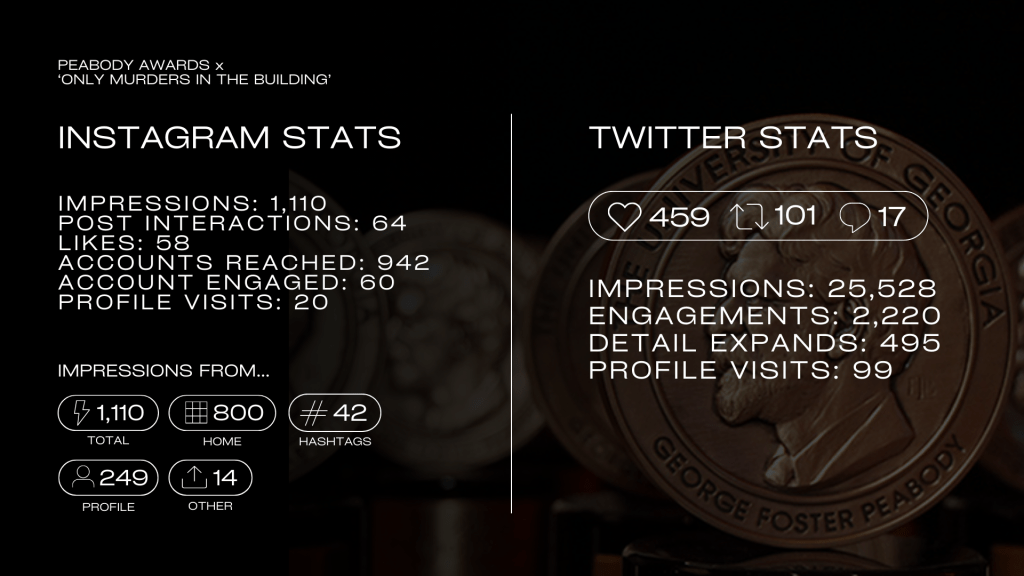







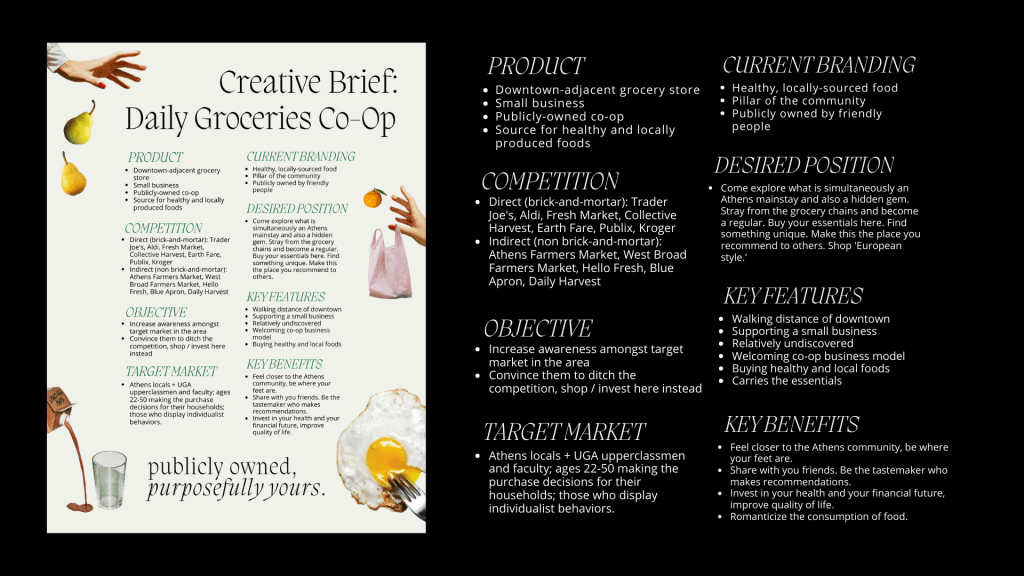




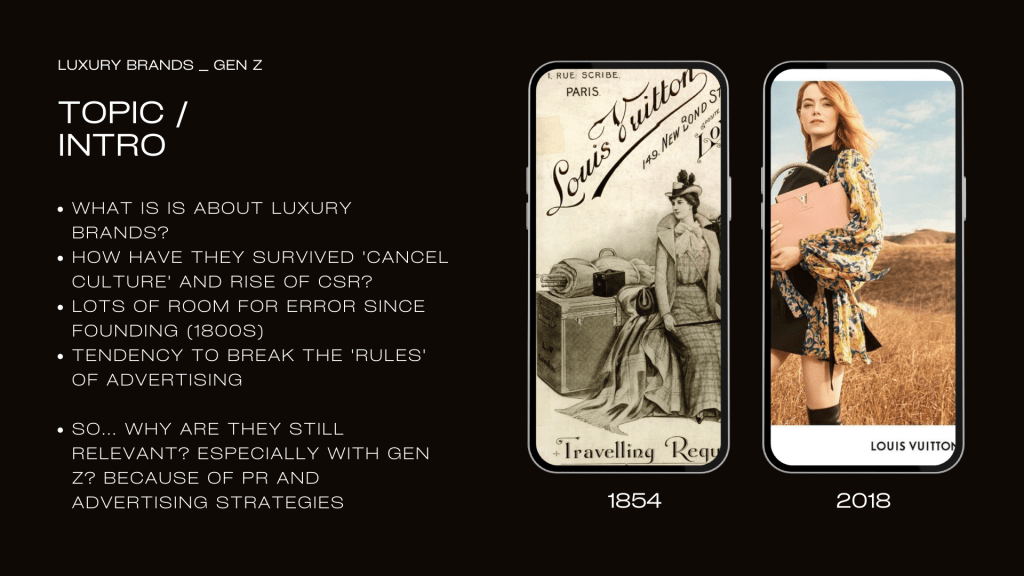


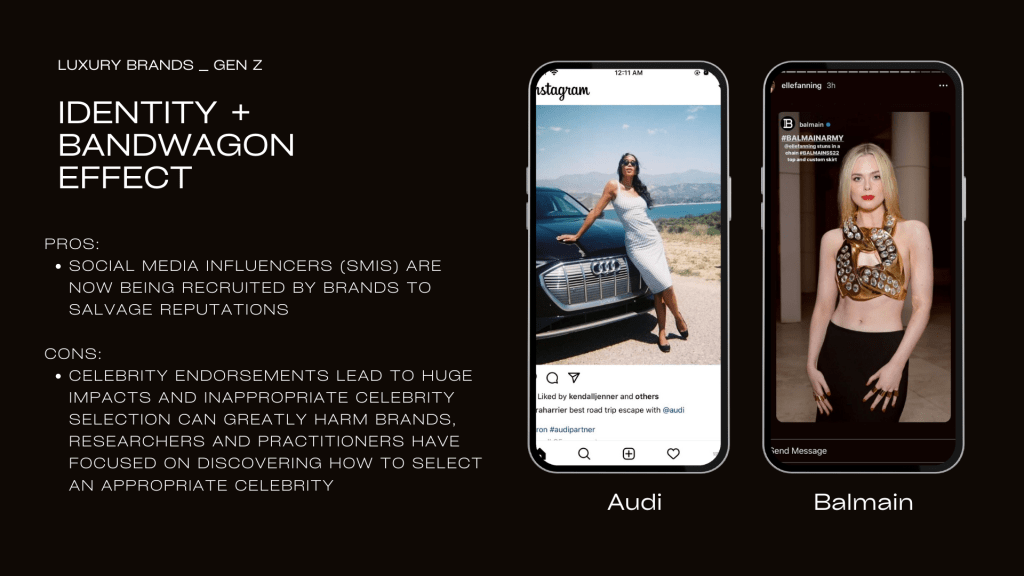
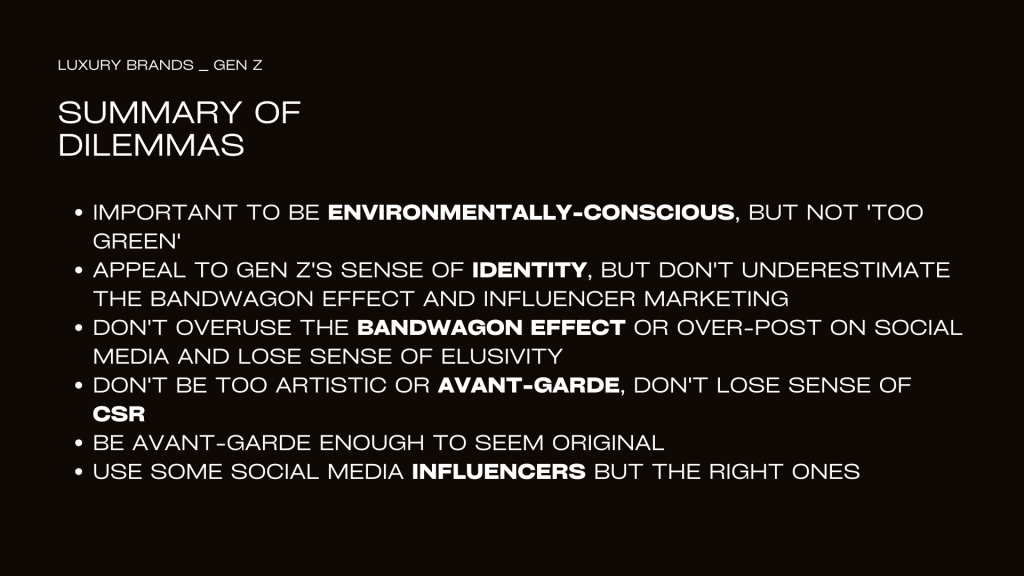


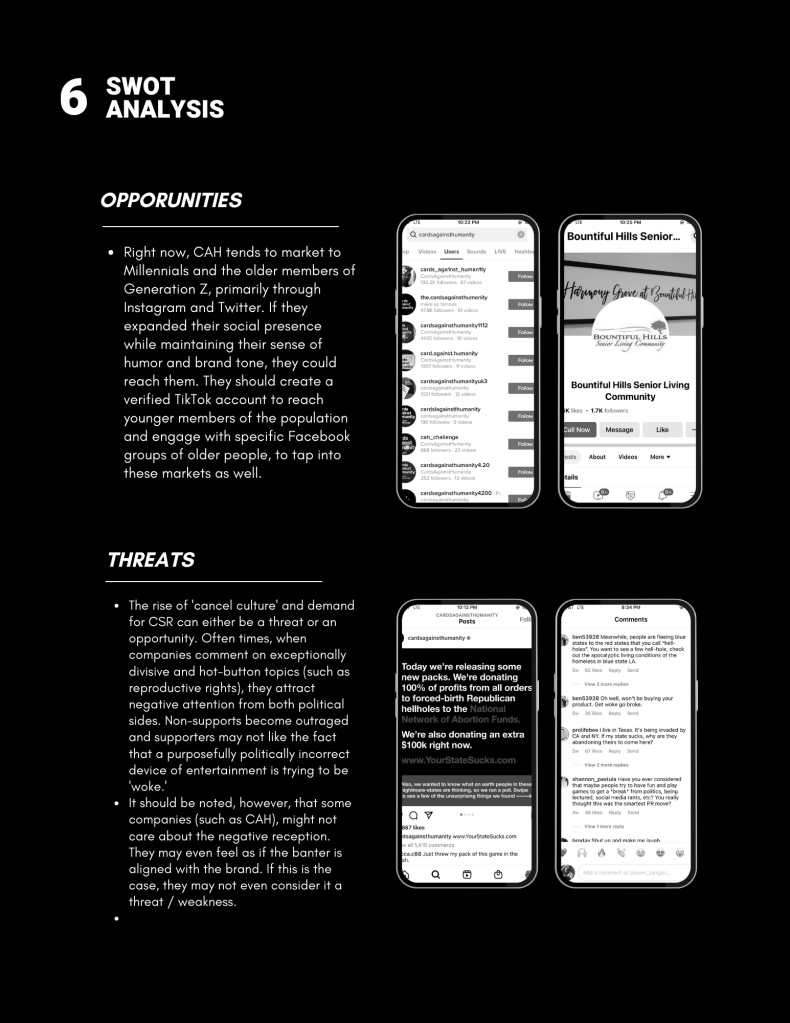





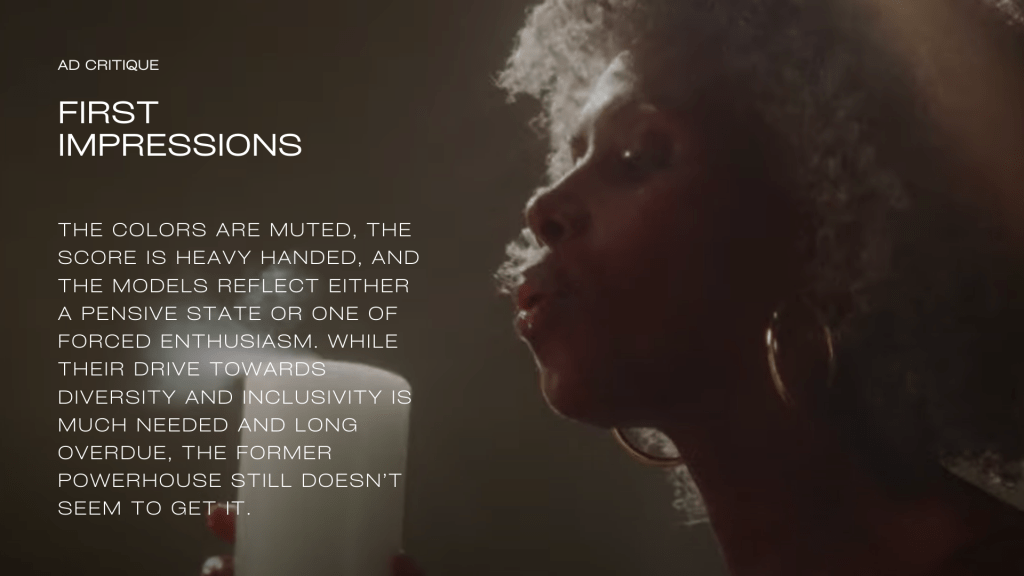

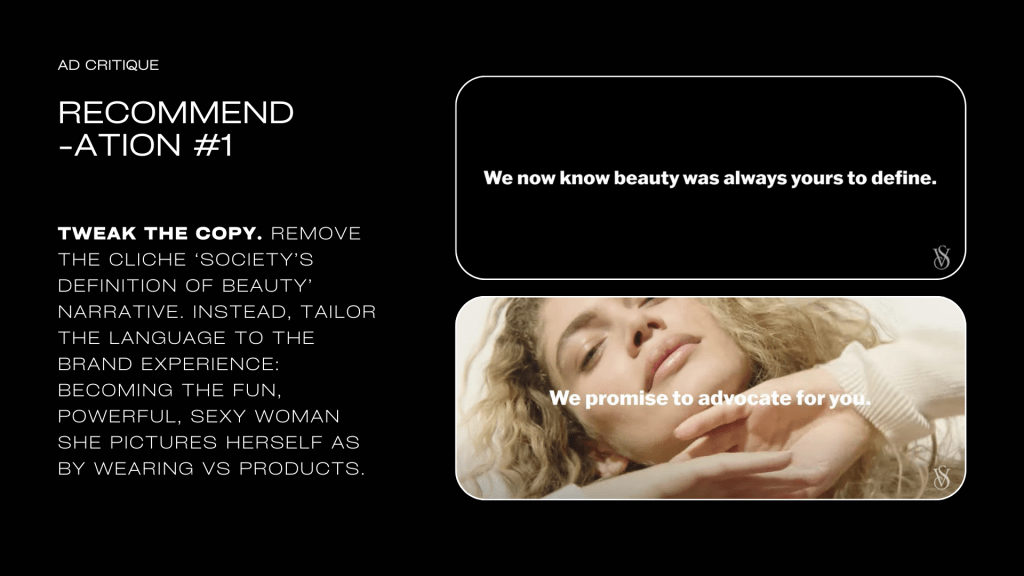
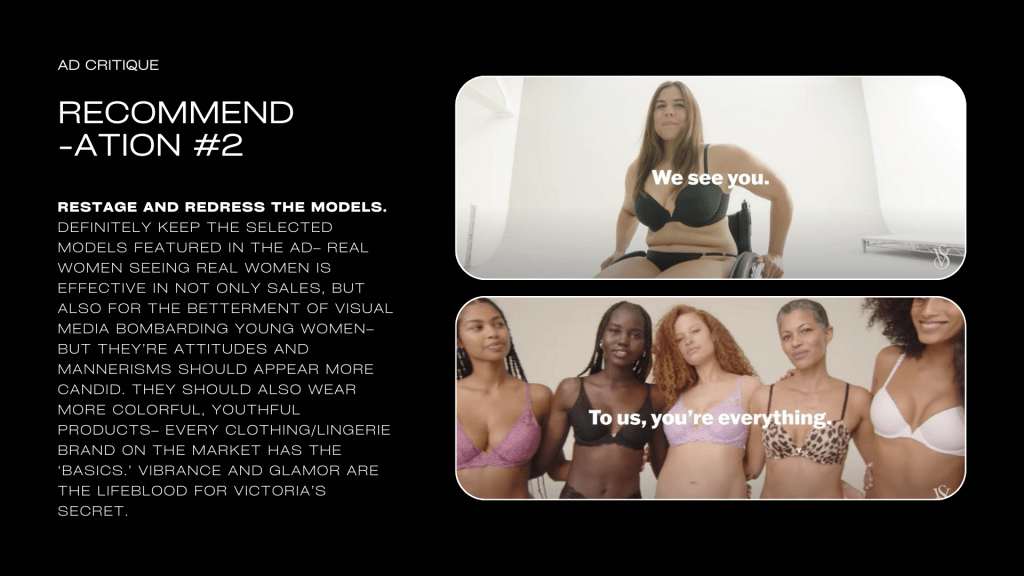
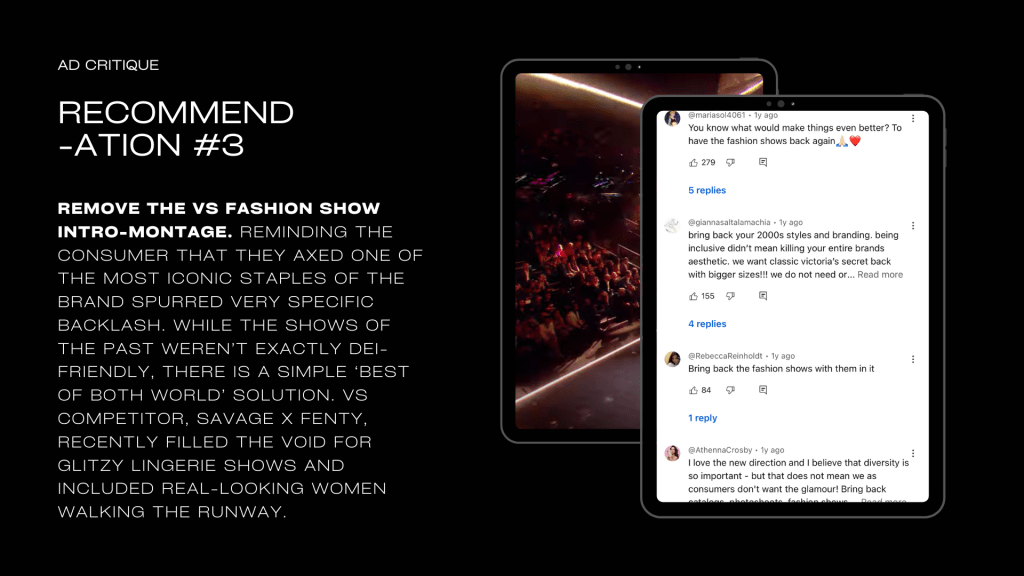


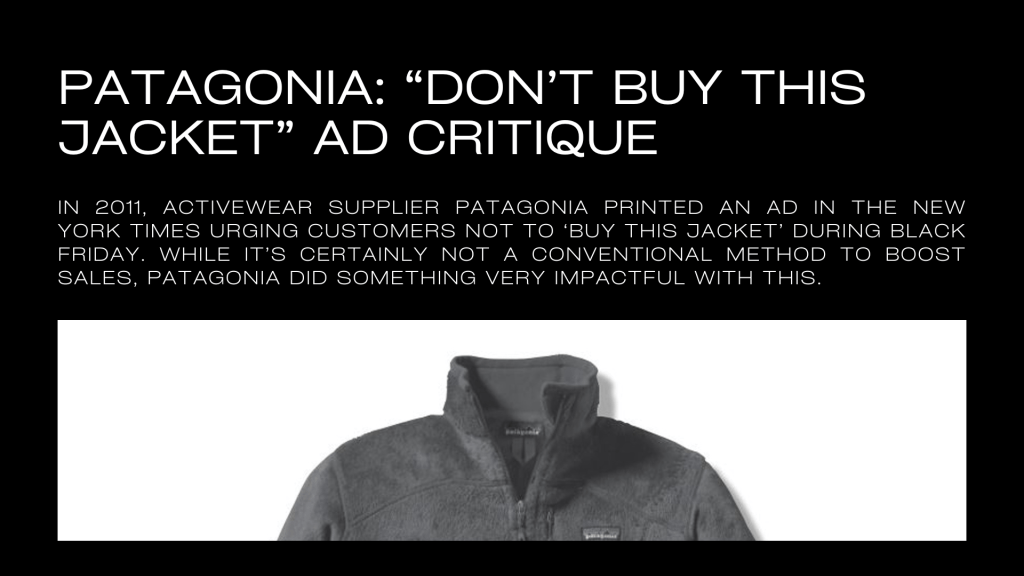
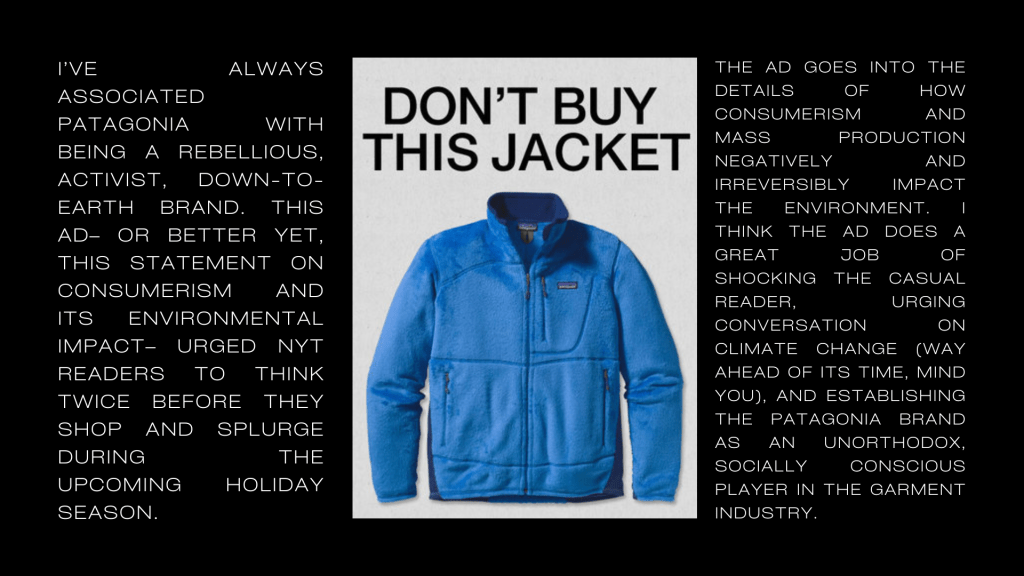


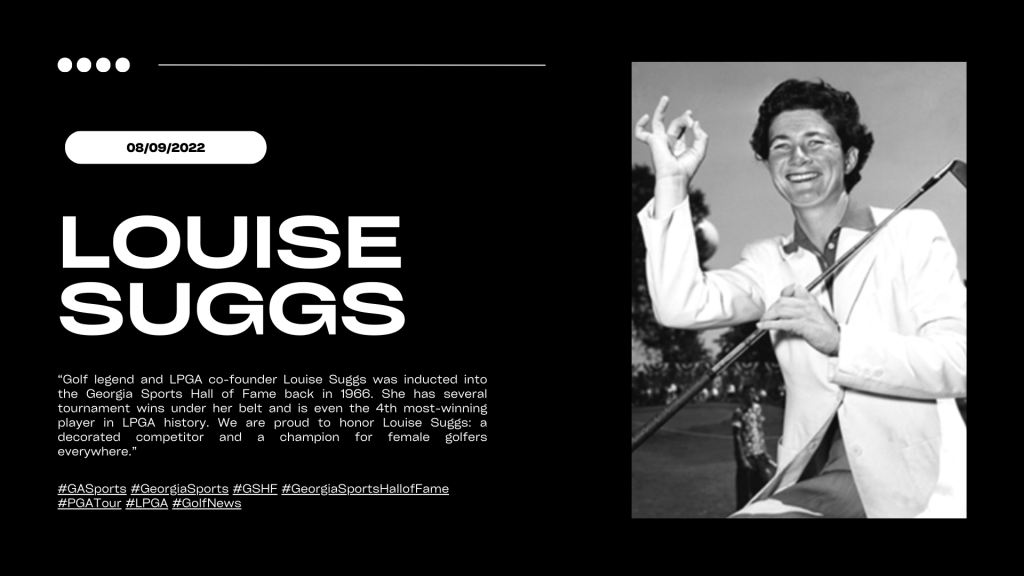


























 KATIE PLOWMAN