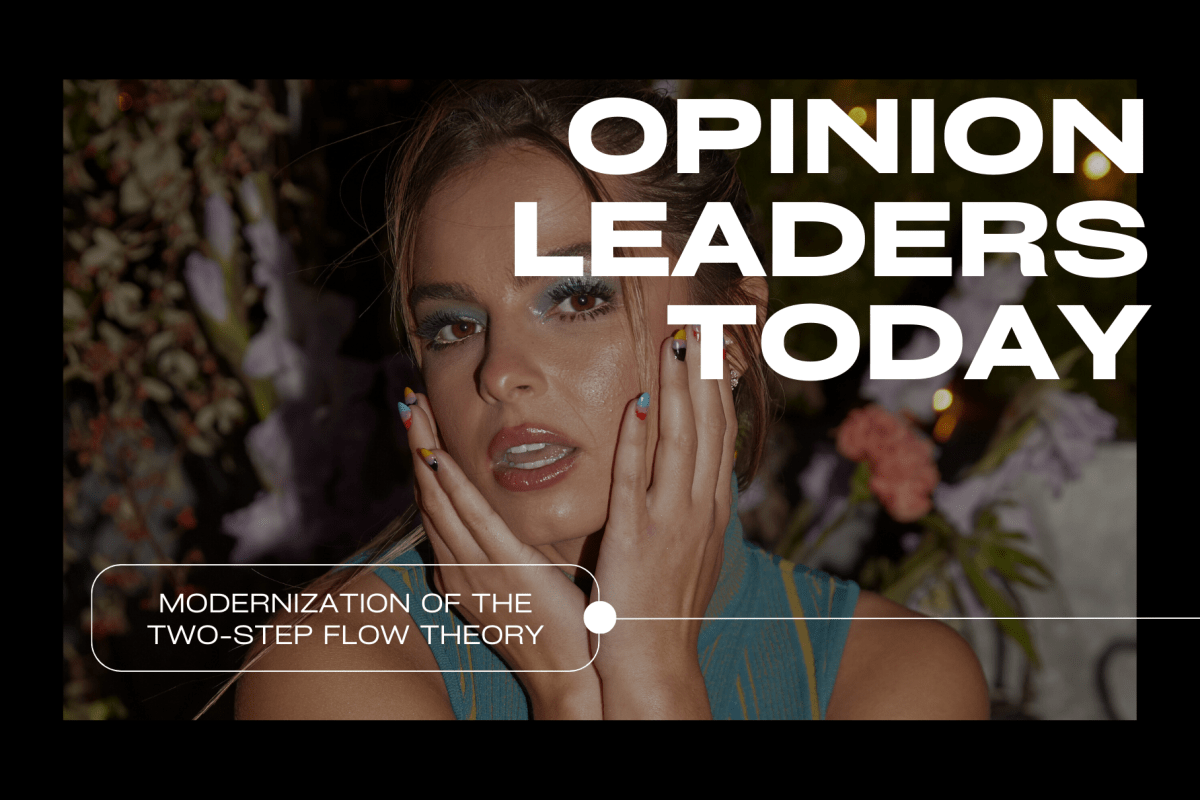
According to the U.S. Chamber of Commerce, influencer marketing – “social media marketing that leverages the influence of individuals with a dedicated social media following” and allows audiences to “engage with a business targeting them as potential customers” – is now an important part of building and maintaining a brand (Fallon & Medina, 2021). Contributors Nicole Fallon and Jacqueline Medina claim that this industry is currently estimated to be worth $13.8 billion as a whole (2021). How did we get here? Is this concept completely new, simultaneously created by the progression of technological advancement? In a sense, yes, but the emergence of this phenomenon is rooted deeper than that.
The concept of the ‘opinion leader’ has been immortalized in writing for nearly a hundred years and has been recognized as an institution for persuasion for even longer than that. According to Britannica, the two-step flow model was formulated in 1948 after researching “voters’ decision-making processes during the 1940 U.S. presidential election” (n.d.). The theory – from the minds of Paul Lazarsfeld, Bernard Berelson and Hazel Gaudet – suggests that ‘opinion leaders,’ or active media collectors, will “collect, interpret, and diffuse the meaning of media messages to less-active media consumers” (Postelnicu, n.d.). Their research reflected that most voters in the 1940s received their decision-making information through word-of-mouth. They casted their votes after being persuaded by opinion leaders who read the newspapers instead of directly reading it themselves. Postelnicu claims that the main takeaway from this data is that mass media has only a finite effectiveness on most people (n.d.).
A major modern-day ‘opinion leader’ shift is the emergence of social media influencers. According to Chris Hazell from Point Loma Nazarene University, basically anybody with access to a smartphone “has the capacity to incite a behavior with his or her followers…(in this sense, anyone with a social media account and a circle of following friends and family can be deemed an influencer)” (2019). Unlike the opinion leader of the past, the social media influencer has more responsibilities than just talking around town and stepping with swagger. Dr. Patrali Chatterjee, a marketing professor at Montclair State University, says that an ideal social media influencer does three things for the brand it promotes: reaches new audiences or segments, develops captivating content, and spots potential trends to capitalize on (2020). Seeing a spokesperson that a viewer knows and trusts creates another indirect establishment of trust to the brand they represent.
Another thing to keep in mind is the scope of today’s media in which social media influencers operate. Elihu Katz from the University of Pennsylvania suggests that our world “has become, paradoxically, both bigger and smaller—more global and more local— making it even more complex” (2015). This so-called paradox has created the demand for specialized influentials on various fields of expertise to demonstrate not only trustworthiness between the influencer and their followers, but relevance to the brand as well. The ‘influencer’ or ‘opinion leader’ of today can be defined by an array of terms.
Two step flow theory defines an opinion leader as a “leader for a certain group who gives details and information to lesser active persons in the group” (2014). As time continues and the way we consume media evolves, this definition has become more universal to address more circumstances. The article explains examples of what an opinion leader in everyday life could look like today: a manager in an office, a politician or activist, or even the matriarch of a family. All of these people have the access and ability to impact their specific groups, but not all. Celebrities also have persuasive abilities over their active fans. Paul Janowski at Forbes warns the reader to be cautious of this concept, however, because “not all influencers are celebrities and not all celebrities are influencers” (2021). The key for correctly utilizing the two-step flow model in today’s public relations field is “finding the right influencer and/or celebrity, then understanding how to extract the value of the partnership” (Jankowsi, 2021). For the best results in a campaign involving opinion leaders, or ‘influencers,’ research is necessary to determine which groups make up the target audience, which content they prefer, and more importantly– which content they actively avoid.
When my team conducted research for the rebrand launch of Access Atlanta, we interviewed and led focus groups with several millennial participants– a significant portion of the target audience. While we did have a set list of questions to ask each person during the interviews, we found that our most insightful responses were prompted by casual, loosely-structured conversation regarding media consumption. Most participants claimed they did not follow any influencers, or if they did, they were rarely prompted to take action or think a certain way based on what they posted. While I don’t think the participants were blatantly lying, I do believe they were unaware of what constitutes an “influencer” when they gave their responses. They all seemed generally adamant about not following ‘Tik Tok dancers,’ ‘Instagram models’ promoting a new product everyday, or famous ‘YouTubers’ with millions of subscribers.
I then asked about types of accounts they do follow. The answers were of a wide variety, but mostly consistent among the interviewees: family members, friends, favored celebrities, politicians/activists, podcast hosts, meme/comedy pages and sometimes strangers with “cool feeds,” like professional artists, writers or photographers. Whether the panelists realize it or not, any of these types of accounts have the potential to qualify as a type of opinion leader, or more specifically– an influencer. The type of ‘news’ the participants seemed to favor, or at the very least consider an ‘escape’ from dreary everyday news, is media revolving around entertainment in some aspect: sports, arts, society, etc. Another insight, courtesy of our interview participants, is the preference for authentic content. This doesn’t appear to be a trend exclusive to our research, however. Hayden Wise from Brigham Young University reports that her interview panelists also try to avoid influencers, because “a majority of them are not very real and show a ‘perfect’ version of themselves” and that several of them admitted to being “critical of an influencer” (2018).
If authenticity is a proven social media strategy and entertainment media is preferred, how can my team apply this to the Access Atlanta campaign? While the team brainstormed a plethora of different brand activations, we had a streamlined focus on engaging with people through social media and the vibrancy of the city. Our overarching concept – “the people you know, the city you love” – is an encapsulation of real Atlantians’ stories and happenings around the town’s entertainment sphere. If our target audience doesn’t follow (or think they follow) the lead of influencers in a trendy sense, then maybe they’ll be more captivated by the opinion leaders of the city they already know and trust. Our activations involving said leaders include neighborhood profiles, artist collaborations, podcasts, and general takeovers or spotlights. Who are these people? Our team utilized beloved professionals from around Atlanta from a variety of different fields: athlete Dansby Swanson, comedian Heather McMahan, artist Stephanie Henderson, and culinary reporting page ATL Foodies. If an ‘influencer’ today can be defined by multiple types of people, why not go even more abstract than that? Could an ‘influencer’ be a partnership, a sponsorship, or an event? If an ‘opinion leader’ is someone with the ability to “collect, interpret, and diffuse the meaning of media messages to less-active media consumers,” then couldn’t something be capable of a similar goal (Postelnicu, n.d.)? Therefore, besides social media activations, event sponsorships are another key part of our team’s campaign. Collaborating with organizations like the Braves, Music Midtown, Atlanta Film Festival, Atlanta International Fashion Week, local bar crawls, etc., can tap into even more subgroups within our target audience.
Determining the preferred content amongst an audience is an ever changing discipline. We know that authenticity and ingenuity are both valued by most millennial social media users, but why? Does humanizing content come across as raw or ‘cool’ in some way? Or does admitting they aren’t leading perfect lives somehow boost their trustworthiness? Both of these things? Or does it just depend on the follower and who they are following?
The early opinion leaders of the 1900s nurtured their powers of persuasion through face-to-face contact: a personal connection. This was pretty much their main sidestep away from traditional media in communicating directly to the masses, considering television and internet were just figments of imagination at the time (Postelnicu, n.d.). Nowadays, people argue the definition of ‘personal connection.’ With the emergence of social media and the institution of the ‘influencer,’ followers often feel personal connections with those they follow, even if it’s strictly one-sided. This connection, however fostered, is still vital. When the masses passively tune out or actively ignore traditional media outlets, opinion leaders always have and always will break through in a way the news cannot: personal connection. While the concept of the ‘opinion leader’ will evolve alongside society and its current technological progressions, we must be aware of the conceptual differences and similarities between influencers of the past, present, and future– in order to understand how to best utilize such an institution for the sake of effectiveness within the public relations field.
References
Chatterjee, P. (2020, November 6). Impact of social media influencers on marketing efforts. montclair.edu. Retrieved December 13, 2021, from https://onlinemba.montclair.edu/how-much-influence-do-your-influencers-have-on-social-media/.
Fallon, N., Medina, J. (2021, December 4). The Top 5 Social Media influencers by industry. https://www.uschamber.com/co. Retrieved December 13, 2021, from https://www.uschamber.com/co/grow/marketing/top-social-media-influencers/amp.
Hazell, C. (2019, October 15). The rise of the Social Media Influencer. Viewpoint. Retrieved December 13, 2021, from https://viewpoint.pointloma.edu/the-rise-of-the-social-media-influencer/.
Jankowski, P. (2021, March 5). Not all influencers are celebrities…not all celebrities are influencers, part 2. Forbes. Retrieved December 13, 2021, from https://www.forbes.com/sites/pauljankowski/2021/03/05/not-all-influencers-are-celebritiesnot-all-celebrities-are-influencers-part-2/.
Katz, E. (2015). Where Are Opinion Leaders Leading Us?. International Journal of Communication, 9 1023-1028. Retrieved from https://repository.upenn.edu/asc_papers/405
Mass Communication. (2014, July 10). Two step flow theory. Communication Theory. Retrieved December 13, 2021, from https://www.communicationtheory.org/two-step-flow-theory-2/.
Postelnicu, M. (n.d.). Two-step flow model of communication. Encyclopædia Britannica. Retrieved December 13, 2021, from https://www.britannica.com/topic/two-step-flow-model-of-communication.
Wise, H. (2018, December 31). Impact of influencers on social media ” Universe narratives. Universe Narratives. Retrieved December 13, 2021, from https://universe.byu.edu/narratives/impact-of-influencers-on-social-media/.
 KATIE PLOWMAN